Tree damage roof repair in St. Louis, MO: decking and rafters
A limb that lands on a roof can break more than shingles. It punctures decking, cracks rafters, and shifts the framing, so we look at the structure from the attic as carefully as the surface.
- Answered 24/7
- Roof Repair
- City, county and Metro East
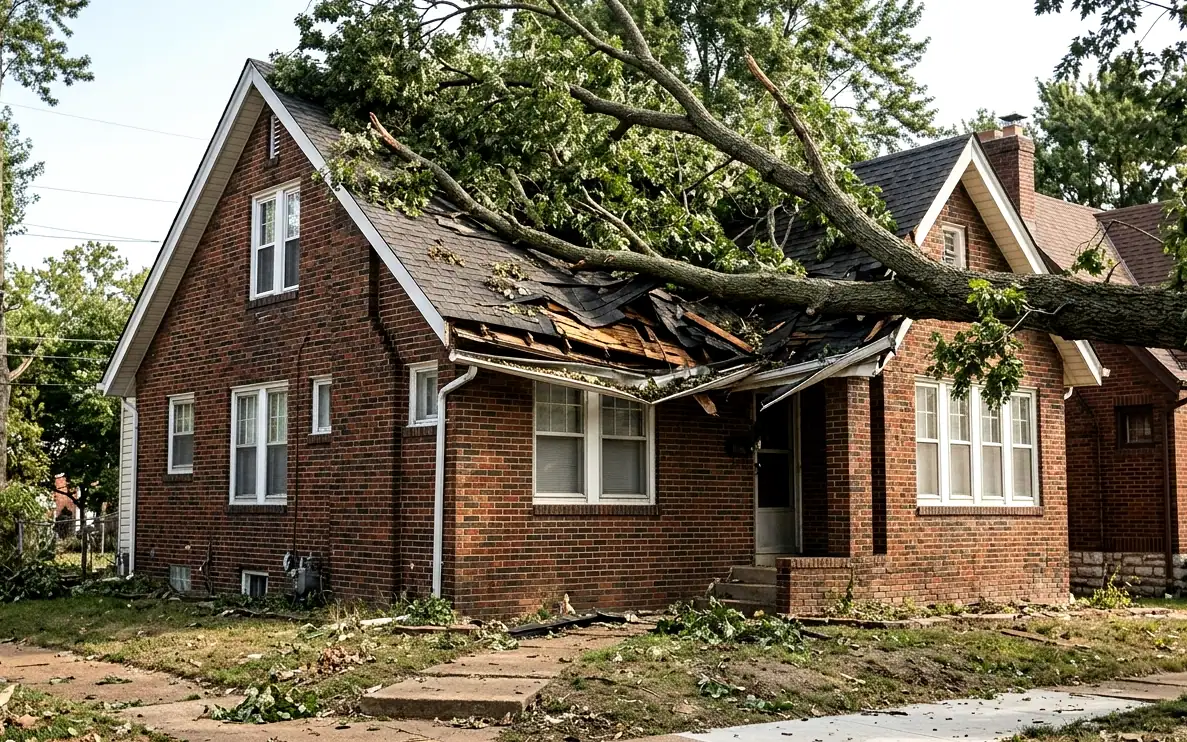
Tree damage roof repair fixes punctured shingles, broken decking, cracked rafters, and crushed edges after a limb or trunk lands on the house. You need it whenever a tree has touched the roof, even if nothing leaks. We check the framing from the attic, shore up weak areas, rebuild the structure, and reroof the section.
How can you tell a tree did more than scrape your roof?
A visible hole or puncture
Any break in the shingles where a limb entered is a likely hole through the decking below. What you see on top is usually smaller than what is damaged underneath.
A sagging or dipped roof line
Stand back and sight along the ridge and eaves. A dip, bow, or sag where the tree landed points to broken rafters or a shifted truss.
Cracked rafters in the attic
Fresh splintered wood, split rafters, or boards sagging between supports show the framing took the blow. Do not step on the ceiling below any cracked area.
Doors and windows sticking
Interior doors that stop closing or windows that bind after a tree strike can mean the framing shifted. A new gap at a door frame is worth reporting.
New cracks in the ceiling
Fresh drywall cracks or nail pops below the strike point suggest the framing above has moved, and the load may no longer be carried the way it was.
Branches scraping the shingles
Limbs that rub against the roof wear off granules and can crack shingles in wind. Even without a strike, overhanging branches deserve attention before a storm.
How we rebuild a roof after a tree strike
- 1
Wait for the load to come off
A tree crew removes the trunk or limb first. We do not work under a tree that is still bearing on the roof, because it can shift or break without warning.
- 2
Inspect framing from the attic
We examine rafters, trusses, ceiling joists, and the underside of the decking for cracks, splits, and sagging, and photograph each damaged member to document the strike.
- 3
Shore up weakened areas
Temporary supports go under cracked framing so it cannot sag further, and the area is covered against rain. The crew then works on a stable structure.
- 4
Rebuild decking and rafters
Cracked rafters are sistered or replaced, and punctured decking is cut back to solid framing and replaced. For trusses, we follow an engineered repair detail.
- 5
Reshingle and blend
New underlayment and shingles are installed across full courses, with ridges and valleys matched, and the repair is sealed so it sheds water like the roof around it.
How we handle tree damage roof repair on St. Louis homes
Tree strikes are structural events. A heavy limb falling from forty feet delivers a concentrated load into one spot, and roof framing was designed for evenly spread snow and shingle weight, not a point blow. The result can be a hole in the sheathing, a cracked rafter beneath it, and a bowed ridge that looks fine from the street.
Before anyone works on the roof, we check it from below. In the attic we look for split or sagging rafters, shifted trusses, and cracked ceiling joists, and from outside we look for dips in the roof line. If the framing is compromised, we shore it up first, so the crew is working on a roof that will hold them. A tree crew removes the trunk or limb, and we work around their schedule.
Repair then follows the damage. Cracked rafters are sistered with new lumber or replaced, punctured decking is cut out and re-laid, and the shingles are rebuilt across full courses instead of patched in a square. Because tree damage often crosses a ridge or hip, we match the ridge line and valleys so the repaired area sheds water like the rest of the roof.
Why St. Louis homes take so many tree hits
Older St. Louis neighborhoods have the kind of mature canopy that makes the city beautiful and puts large limbs over many roofs. Oaks, maples, and other big trees shade streets in south city, the inner suburbs, and the county. In spring storms, heavy limbs snap and fall, and saturated soil loosens roots, so a tree can come down in winds that would not usually topple it.
The type of framing changes the repair. Older homes have solid-lumber rafters that can often be sistered with new boards. Newer homes in St. Charles County and parts of the county have engineered trusses, and a damaged truss usually needs an engineered repair. Knowing which system your house has tells us how to shore it and what the structural fix involves for your particular roof.
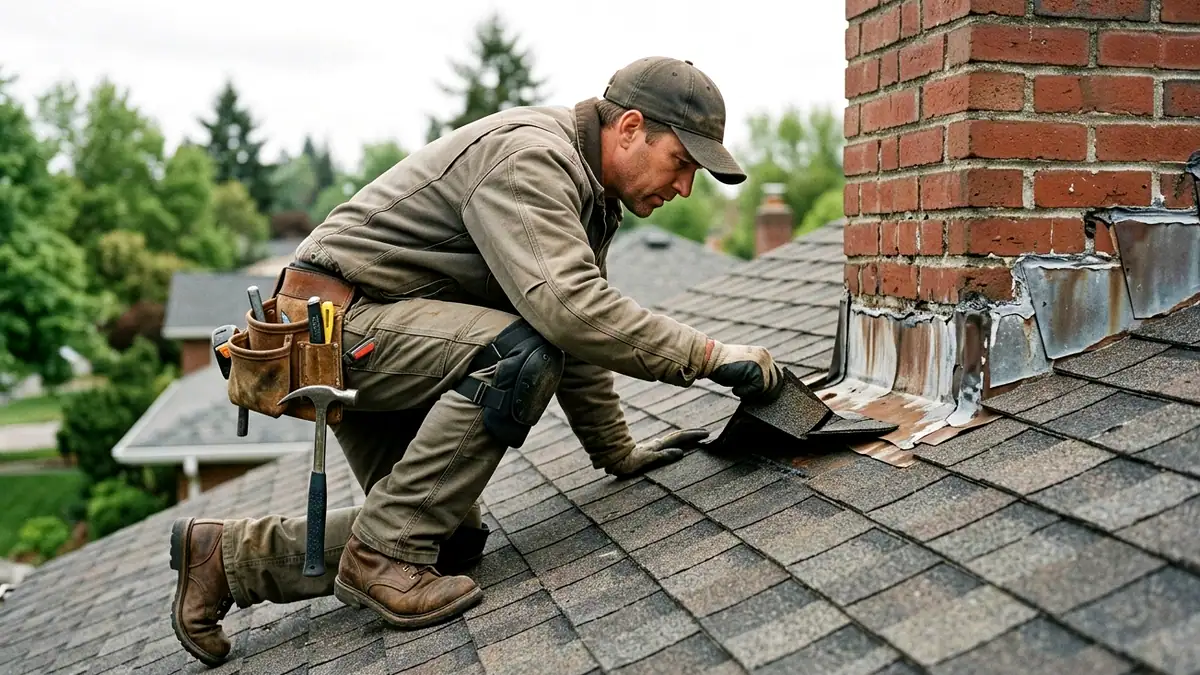
How we rebuild framing and surface after a tree strike
Sister damaged rafters
A new board is fastened alongside a cracked rafter to restore its strength. It is a proven repair for solid-lumber framing and keeps the original structure intact.
Engineered truss repair
Damaged trusses cannot be patched by guesswork. We use a repair detail drawn by an engineer, which restores the load path the truss was built to carry.
Decking replacement
Broken plywood or boards are cut back to the nearest rafters and replaced with new sheathing, giving the shingles a flat, solid base again.
Course-by-course reshingle
Instead of patching a square, we reshingle across full courses and tie into the surrounding roof, so the repair blends in and sheds water evenly.
What does tree damage roof repair cost in St. Louis?
Tree damage is structural, so it costs more than a shingle repair. The main drivers are how much framing is cracked, how large the opening is, and how much of the roof must be rebuilt. Truss repairs need an engineer's detail, which adds cost. Steep or tall roofs take more safety setup, and interior damage from rain, if any, is separate from the roof work.
Compare every roofing and siding price range or plan the order of your exterior work.
| Work | Typical range |
|---|---|
| Puncture repair, decking and shingles | $840 to $2,170 |
| Rafter sistering, per damaged rafter | $395 to $985 |
| Truss repair with engineered detail | $1,480 to $3,945 |
| Large rebuild after a trunk strike | $4,260 to $11,830 |
These ranges are typical for tree damage repairs in St. Louis, not a quote, and a large trunk strike can run well beyond them.
Where we handle tree damage roof repair
The city, the counties and the towns below cover most of the homes we work on. If yours is not listed, call and ask.
- City of St. Louis 63102
- St. Louis County, MO 63105
- St. Charles County, MO 63301
- Florissant, MO 63031
- Chesterfield, MO 63017
- Oakville, MO 63129
- St. Charles, MO 63301
- O'Fallon, MO 63366
- St. Peters, MO 63376
- Kirkwood, MO 63122
- Mehlville, MO 63125
- Belleville, IL 62220
- University City, MO 63130
- Ballwin, MO 63011
- Wentzville, MO 63385
- Hazelwood, MO 63042
- Webster Groves, MO 63119
- Edwardsville, IL 62025
- Collinsville, IL 62234
- Alton, IL 62002
- O'Fallon, IL 62269
- Arnold, MO 63010
- Affton, MO 63123
- Jefferson County, MO 63050
Shingle, siding and window lines we install and repair around St. Louis include GAF, Owens Corning, CertainTeed and James Hardie, plus the other brands below.
- GAF
- Owens Corning
- CertainTeed
- IKO
- Atlas
- Malarkey
- James Hardie
- LP SmartSide
- Alside
- Mastic
- DaVinci
- Velux
- Carlisle
- Firestone
Tree Damage Roof Repair questions
Do I have to remove the tree before you can start tree damage roof repair?
Yes, the tree has to be off the roof first. A trunk or limb still bearing on the framing can shift or break, and it hides damage underneath. A tree service removes it, and we can cover the opening before and after so rain stays out.
How do you know a rafter is cracked after a limb hit my roof?
We look at the rafters from the attic for splits, fresh splintered wood, and sagging, and we sight the roof line from outside for dips. A cracked rafter often shows as a clear break with raw wood, near where the limb landed.
Can a tree strike damage the roof even if no hole is visible?
Yes. A heavy limb can crack a rafter or loosen a truss connection without puncturing the shingles. The roof line may dip slightly, or ceilings may crack below. Inspecting the framing from the attic is the only way to be sure.
Is it safe to stay in a house with a cracked roof truss?
It depends on the damage, and we cannot judge it over the phone. If you see sagging, new ceiling cracks, or hear creaking, stay out of the rooms under the damage and call. We inspect and support the framing before anyone relies on it.
Will you match my ridge line after a tree damage repair?
Yes. We rebuild the ridge and any hips or valleys to follow the original lines, and we tie new shingles into the old across full courses. The goal is a repair that sheds water the same way as the rest of your roof.
Related work we often pair with tree damage roof repair
Emergency Roof Tarping
Temporary dry-in. A tarp is not a repair.
Roof Decking Replacement
The layer under your roof. Decking is the wood your whole roof is nailed to, and it often hides rot, gaps, or old plank spacing.
Storm Damage Roof Repair
After the storm passes. A severe storm seldom hurts a roof in just one way.
Emergency Roof Repair
Roof emergency, any hour. A limb through the roof at midnight or water pouring through a ceiling on Sunday does not wait for business hours.
Need tree damage roof repair in St. Louis?
Call any hour. A roofer answers, asks a few questions and sets up a visit.