EPDM rubber roofing in St. Louis for brick flats and rowhouses
EPDM is a flexible synthetic rubber sheet, glued down in large pieces with few seams. Rowhouse and flat owners in St. Louis choose it for rear roofs because it handles cold snaps and stays easy to repair.
- Answered 24/7
- Flat & Commercial Roofs
- City, county and Metro East
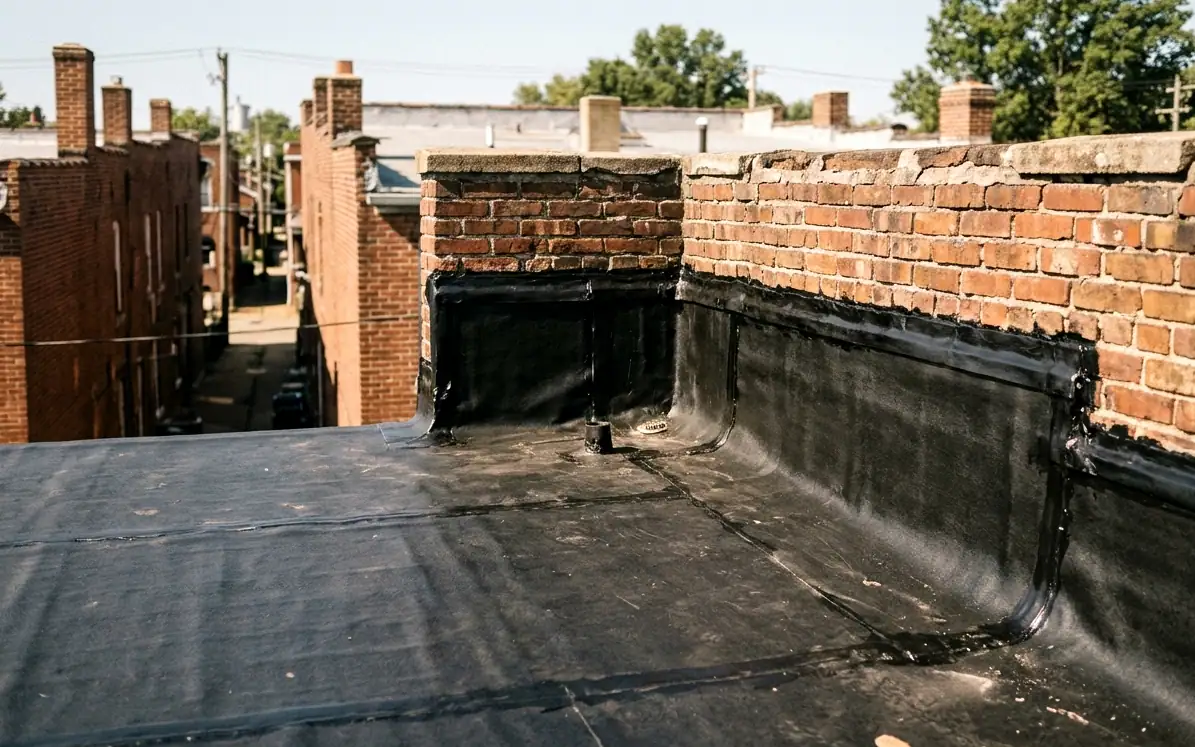
EPDM rubber roofing is a single-ply synthetic rubber membrane, usually black, adhered or ballasted over insulation on a flat roof. Large sheets mean fewer seams, and the rubber stays flexible in cold weather. It suits small, simple roofs like rear roofs on St. Louis flats. A visit covers measurements, substrate checks, flashing details and a sheet thickness recommendation.
How we handle EPDM rubber roofing on St. Louis homes
EPDM stands for ethylene propylene diene monomer, the same family of synthetic rubber used in car weatherstripping. Roofing sheets are made in widths from ten feet to fifty feet or more, so a typical rear roof on a two-family flat can be covered with one or two pieces and almost no field seams. Fewer seams mean fewer places for water to find a way in.
Installation is simpler than with most membranes. The sheet is unrolled, relaxed, folded back and adhered to the substrate with bonding adhesive, or it is held down with ballast stone or fasteners. Corners and penetrations get molded or hand-built flashing from uncured rubber and seam tape. Because the work involves adhesive and no open flame or hot-air welding, it can be a good fit for tight rowhouse conditions.
The tradeoffs are real. Black EPDM absorbs heat, and the standard thickness of 45 mil can puncture under heavy traffic or falling branches. White-faced EPDM and 60 mil sheet address some of that. We explain where EPDM is the best choice and where TPO or modified bitumen would serve the same roof better, based on the roof and not on what is easiest for us to install, then you decide.
EPDM sheet, color and attachment options
45 mil or 60 mil sheet
Forty-five mil is the common residential choice. Sixty mil adds puncture resistance, which helps under overhanging trees, around mechanical equipment, or on roofs that people walk on often.
Fully adhered rubber
The whole sheet is adhered to the substrate. It is the standard for small, low-slope rear roofs because it lies flat, resists billowing, and keeps the surface tidy.
Ballasted or fastened
Loose-laid sheets held by stone ballast or mechanical fasteners suit larger roofs with strong decks. We rarely use ballast on older flats because the added weight stresses joists.
Black or white-faced rubber
Black is the standard and the least costly. White-faced EPDM reflects more heat and helps on top-floor units, though it costs more and shows dirt faster.
What an EPDM rubber roof costs in St. Louis
EPDM is often the most economical of the single-ply systems on small roofs. Cost depends on sheet thickness, the insulation under it, how many corners and curbs need flashing, and whether the old roof must come off. Access matters, too. Hauling rolls up through an alley or over a neighboring roof adds labor. We provide an itemized range after reviewing your roof, so you can see where each dollar goes.
Compare every roofing and siding price range or plan the order of your exterior work.
| Work | Typical range |
|---|---|
| Small rear roof, rubber over a dry layer | $3,480 to $6,310 |
| Tear-off, insulation and EPDM, two-family roof | $7,860 to $14,590 |
| Parapet wall flashing and termination | $945 to $2,720 |
| Pipe boots, corner flashings and drain work | $385 to $1,240 |
These figures are typical St. Louis ranges for planning and not quotes, since each roof is priced after an inspection.
How we install an EPDM rubber roof
- 1
Prepare the substrate
We remove old roofing or confirm a recover is possible, repair deck boards, and install insulation and a cover board so the rubber lies on a clean, smooth, dry surface.
- 2
Dry-fit and relax the sheet
The EPDM sheet is unrolled and left to relax in the sun, which removes wrinkles and lets us trim it accurately to the roof outline and the parapet height.
- 3
Bond with adhesive
The sheet is folded back in halves, bonding adhesive is rolled onto both surfaces, and once tacky the rubber is pressed down and brushed smooth to remove trapped air.
- 4
Flash corners and penetrations
Inside and outside corners, pipes and curbs get molded pieces or hand-built flashing using primer, seam tape and uncured rubber, all pressed with a roller.
- 5
Terminate and seal edges
Edges are fastened under a termination bar or metal coping, sealed with lap sealant, and the finished roof is walked with you using photos of every flashing detail.
Why choose EPDM for a small St. Louis flat roof?
Small rear roof with few seams
A rear roof on a rowhouse or flat is often a single plane. One large sheet of rubber covers it with almost no field seams to maintain.
Cold-weather flexibility matters
EPDM stays pliable in freeze-thaw cycles and does not crack at low temperatures, which suits St. Louis winters and the building movement that goes with them.
Old roof keeps failing at seams
Tar-sealed laps and built-up edges let go over time. A large adhered rubber sheet replaces many weak laps with a few well-adhered ones.
You want a repair-friendly roof
Cut or scuffed EPDM can be cleaned, primed and patched with tape or uncured flashing. Most local repairs take a short visit and very little material.
Rooftop work is tight and shared
Rowhouse roofs sit close to neighbors and chimneys. Cold adhesives avoid torch heat near old wood framing and shared walls, which suits cramped access.
Budget for a straightforward roof
EPDM is often the lowest cost of the major single-ply options per square foot, especially on simple, low-detail roofs where the rubber sheet does most of the work.
EPDM on St. Louis flats, rowhouses and storm-prone roofs
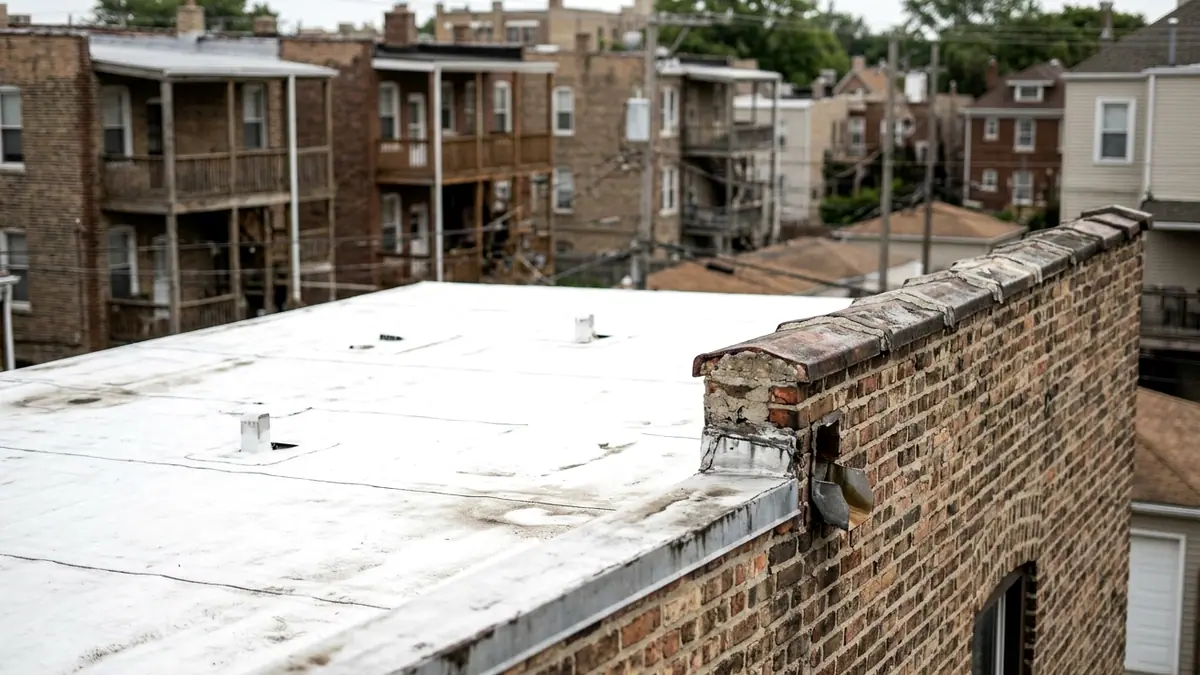
Rubber roofs have a long history on city flats because they cover the odd shapes of rear roofs. Many south city rear roofs sit at the back of the building, framed with wood joists and bordered by a brick parapet on three sides. A single EPDM sheet can be wrapped up the parapet face and terminated under coping, which gives the roof a continuous skin from edge to edge. The same sheet also wraps around chimney bases and plumbing stacks.
Weather decides the details. Hail season from March through June can leave scuffs and punctures in thin rubber, so we use 60 mil sheet on roofs with tree overhang or heavy exposure. In January and February, freeze-thaw cycles stress every seam, which is why we reinforce corners with factory-made flashing pieces. Debris in box gutters and scuppers is the other common local issue, and we clear and reline them during the job.
Where we handle EPDM rubber roofing
The city, the counties and the towns below cover most of the homes we work on. If yours is not listed, call and ask.
- City of St. Louis 63102
- St. Louis County, MO 63105
- St. Charles County, MO 63301
- Florissant, MO 63031
- Chesterfield, MO 63017
- Oakville, MO 63129
- St. Charles, MO 63301
- O'Fallon, MO 63366
- St. Peters, MO 63376
- Kirkwood, MO 63122
- Mehlville, MO 63125
- Belleville, IL 62220
- University City, MO 63130
- Ballwin, MO 63011
- Wentzville, MO 63385
- Hazelwood, MO 63042
- Webster Groves, MO 63119
- Edwardsville, IL 62025
- Collinsville, IL 62234
- Alton, IL 62002
- O'Fallon, IL 62269
- Arnold, MO 63010
- Affton, MO 63123
- Jefferson County, MO 63050
Shingle, siding and window lines we install and repair around St. Louis include GAF, Owens Corning, CertainTeed and James Hardie, plus the other brands below.
- GAF
- Owens Corning
- CertainTeed
- IKO
- Atlas
- Malarkey
- James Hardie
- LP SmartSide
- Alside
- Mastic
- DaVinci
- Velux
- Carlisle
- Firestone
EPDM Rubber Roofing questions
How is EPDM rubber roofing different from TPO?
EPDM is a thermoset rubber glued or ballasted in large sheets, with seams sealed by tape. TPO is a thermoplastic whose seams are welded with hot air. EPDM is more flexible in cold weather and costs less on simple roofs. TPO reflects more heat. We explain which fits your roof.
Will a black rubber roof make my top floor hotter?
A black membrane absorbs more heat than a white one, so the surface gets hotter in July. Extra insulation under the rubber keeps most of that heat out of the unit below. If cooling cost is a priority, white-faced EPDM or a white TPO roof reduces it further.
Can a punctured EPDM roof be repaired without replacing it?
Often yes. We clean the area, apply primer and press a patch of cured or uncured rubber over the puncture with tape-sealed edges. This works while the surrounding rubber is flexible and not shrunken or cracked. If the sheet has pulled away at corners, a broader repair or replacement makes more sense.
How long does an EPDM rubber roof install take?
A rear roof on a two-family flat usually takes one to two days once the substrate is ready. Adhesive needs dry weather and moderate temperatures, so we pick the install window carefully. Larger roofs or those needing deck repairs take longer, and we give you the working window at the start.
Does the adhesive smell during EPDM installation?
The bonding adhesive does have a strong solvent odor while it is applied and dries, usually for a few hours. We advise closing windows near the work area and running fans in the unit below. Water-based adhesives are available for some projects, and we discuss options before the job starts.
Related work we often pair with EPDM rubber roofing
Flat Roof Replacement
Tear-off and a new flat roof. When patches stop holding, a full replacement resets the whole low-slope roof.
Flat Roof Repair
Low-slope roof leaks fixed. Most St.
TPO Roofing
Welded white flat roofing. TPO is a single-ply white membrane whose seams are welded with hot air into one continuous sheet.
Modified Bitumen Roofing
Layered cap sheet roofing. Modified bitumen is a layered asphalt roof, reinforced with polyester and finished with a granulated cap sheet.
Need EPDM rubber roofing in St. Louis?
Call any hour. A roofer answers, asks a few questions and sets up a visit.