Chimney tuckpointing and rebuild in St. Louis brick homes
Old St. Louis chimneys carry a lot of weather on a narrow column of brick. We grind out failed mortar, replace damaged brick and rebuild leaning stacks so the masonry stands straight again.
- Answered 24/7
- Roof Care & Claims
- City, county and Metro East
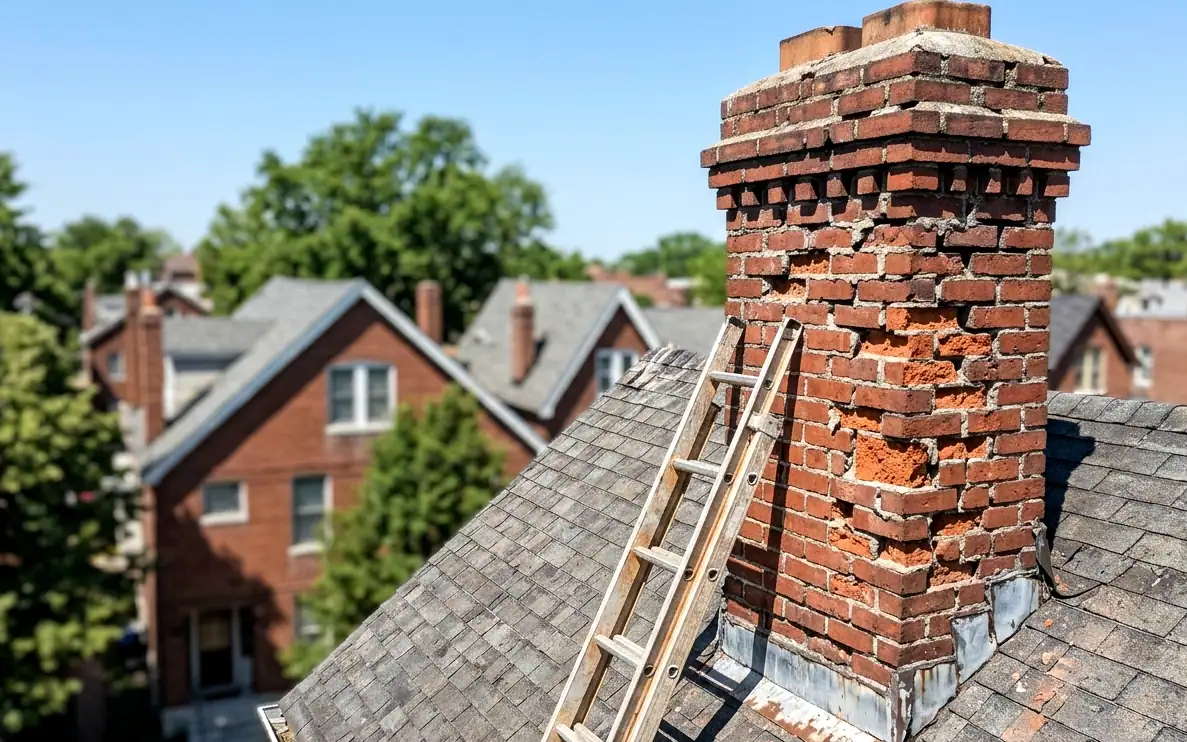
Chimney tuckpointing and rebuild repairs the brick and mortar of the chimney itself. Tuckpointing replaces crumbling joints, brick replacement fixes spalled faces, and a rebuild takes the stack down and relays it from the roofline. You need it when mortar falls out, bricks flake, or the chimney leans. We inspect, explain the options and show photos.
How we handle chimney tuckpointing & rebuild on St. Louis homes
A brick chimney is a tall, narrow column with weather hitting every side. Mortar is the softest part of it, designed to wear before the brick does. After many decades it erodes, joints open and water works into the stack. Tuckpointing removes the failed mortar to a uniform depth and packs in fresh mortar, which restores the seal and gives the chimney many more seasons.
Brick damage is the next stage. Water that enters a joint freezes in winter and pushes the face off the brick, a failure called spalling. Individual spalled bricks can often be cut out and replaced with matching brick, as long as the surrounding masonry is sound. If many bricks have lost their faces, or the mortar is so far gone that bricks come out by hand, repair stops being the right answer.
A rebuild takes the chimney down course by course, usually from the roofline up, and relays it with new mortar and sound brick. We can rebuild only the top section that is failing or the whole stack above the roof. Any flashing, crown or cap work is coordinated as part of the job, though those repairs have their own pages. The aim is a straight, solid chimney that does not need attention again soon.
What chimney masonry options do you have?
Tuckpoint the joints
For sound brick with weathered mortar, grinding out and repacking the joints is the most economical repair. It also gives the chimney a clean, uniform look.
Replace spalled brick
Individual damaged bricks are cut out and replaced with brick matched by size, color and texture. It stops moisture from entering at the weakest points.
Rebuild the top section
When only the upper courses have failed, we take down just that section and relay it. It costs less than a full rebuild and fixes most weather damage.
Full rebuild from the roofline
A leaning or deeply deteriorated chimney is removed above the roof and relaid with sound masonry, new flashing and a proper crown, for a stack that lasts decades.
What does chimney masonry work cost in St. Louis?
Cost follows the size of the chimney, its height above the roof and how much brick needs work. Tuckpointing is priced by the square foot of masonry, replacement brick by the piece, and a rebuild by the height and width of the stack. Matching old brick can add time, as can steep roofs and tight access in city neighborhoods. Larger two-flue chimneys cost more than single-flue stacks.
Compare every roofing and siding price range or plan the order of your exterior work.
| Work | Typical range |
|---|---|
| Tuckpoint chimney above roof, small stack | $742 to $1,863 |
| Replace spalled bricks, per area | $384 to $1,129 |
| Rebuild top section of chimney | $1,486 to $3,274 |
| Full rebuild from roofline, single flue | $2,846 to $6,397 |
These 2026 St. Louis figures are typical ranges for planning, not quotes, and tall, wide or two-flue chimneys can run higher.
How a chimney masonry repair goes
- 1
Inspect the stack closely
We look from the ground, then from the roof, probing mortar depth, checking for lean, loose bricks and cracks, and noting how the chimney meets the house before we decide on a scope.
- 2
Choose repair or rebuild
Sound brick with failed joints gets tuckpointing. Scattered spalled bricks get replaced one by one. A leaning or crumbling stack is rebuilt, and we explain why with photos.
- 3
Grind out and match mortar
Failed joints are ground to a clean, even depth. We mix mortar to match the color and hardness of the original, so it protects old brick instead of damaging it.
- 4
Replace or relay brick
Damaged bricks are cut out and replaced with matching units. In a rebuild, the stack comes down from the roofline up and is relaid course by course, plumb and level.
- 5
Coordinate flashing and finish
We arrange new flashing at the roof junction as the masonry is completed, clean the brick, and show you the finished chimney in photos before we take down the ladders.
How do you know a chimney needs masonry work?
Mortar crumbling or missing
Joints that are sandy, recessed more than a quarter inch, or empty let rain soak the brick. You may find grit on the roof or in the gutters below the chimney.
Brick faces flaking off
Bricks with peeled or pitted faces, or orange dust on the roof, are spalling. Water has entered the brick and frozen, pushing the surface away in thin pieces.
Chimney leaning from the roof
Sight along the stack from the yard. A visible tilt, a gap where the chimney meets the house, or stair-step cracks mean the masonry is moving and needs a closer look.
White staining on the brick
A white crust, called efflorescence, shows water traveling through the masonry and evaporating at the surface. Heavy staining usually means joints are open or the brick is saturated.
Loose bricks at the top
Bricks that wiggle or have shifted near the top of the stack can fall during wind or ice. Debris in the yard or flower beds is a strong clue.
Smoke or water in the flue
Damp chimney walls inside, water stains on the fireplace, or flue tile fragments in the firebox can mean the masonry above has opened up and let weather inside.
Why St. Louis chimneys wear out their mortar
Much of the city's housing stock was built between 1880 and 1950 with brick chimneys on both sides of the roof, many with lime-rich mortar that was soft by design. Today those joints have often been repointed with harder modern mortar, which can trap moisture and damage old brick. We look at what is on the chimney first, so new mortar suits the existing brick instead of causing the next round of spalling.
Weather is the other half. St. Louis cycles through humid summers, spring storms and winter freezes, and a chimney is the most exposed masonry on a house. Rain soaks in, then freeze-thaw pushes on the brick from inside. Older stacks also stand taller than the roof, so wind loads them. Newer subdivisions in St. Charles County have a different problem: thin veneer chimneys with cracked mortar where the frame has settled.
Where we handle chimney tuckpointing & rebuild
The city, the counties and the towns below cover most of the homes we work on. If yours is not listed, call and ask.
- City of St. Louis 63102
- St. Louis County, MO 63105
- St. Charles County, MO 63301
- Florissant, MO 63031
- Chesterfield, MO 63017
- Oakville, MO 63129
- St. Charles, MO 63301
- O'Fallon, MO 63366
- St. Peters, MO 63376
- Kirkwood, MO 63122
- Mehlville, MO 63125
- Belleville, IL 62220
- University City, MO 63130
- Ballwin, MO 63011
- Wentzville, MO 63385
- Hazelwood, MO 63042
- Webster Groves, MO 63119
- Edwardsville, IL 62025
- Collinsville, IL 62234
- Alton, IL 62002
- O'Fallon, IL 62269
- Arnold, MO 63010
- Affton, MO 63123
- Jefferson County, MO 63050
Shingle, siding and window lines we install and repair around St. Louis include GAF, Owens Corning, CertainTeed and James Hardie, plus the other brands below.
- GAF
- Owens Corning
- CertainTeed
- IKO
- Atlas
- Malarkey
- James Hardie
- LP SmartSide
- Alside
- Mastic
- DaVinci
- Velux
- Carlisle
- Firestone
Chimney Tuckpointing & Rebuild questions
How do I tell if my chimney needs repointing or a full rebuild?
If the bricks are firm and only the joints have eroded, repointing is enough. If bricks come out by hand, many faces are flaking, or the stack leans or has stair-step cracks, a rebuild is safer. We probe the mortar and bricks and explain what we find with photos.
Can spalled bricks on an old chimney be replaced one at a time?
Yes, when the damage is scattered and the rest of the masonry is sound. We cut out the bad brick, set a matching one with compatible mortar and tool the joint. If spalling covers a large share of the stack, replacing the whole section holds up better.
How do you match old brick and mortar color on a chimney?
We compare size, texture and color against the existing brick, using salvaged or new units that blend as closely as possible. Mortar is mixed in test batches to match both color and hardness. New mortar that is harder than the old brick can cause cracking, so we avoid it.
Do I have to stop using my fireplace while you rebuild the chimney?
Yes, during the work. Tuckpointing usually takes a day or two, while a rebuild can take several days with curing time before the fireplace should be used. We cover the top of the flue so debris stays out, and we tell you when it is safe to light a fire again.
Is it safe to leave a leaning chimney alone for a winter?
It depends on the lean and the cracking. A stable lean with sound joints may wait for a planned repair, but a chimney that is moving or dropping bricks is a risk to the roof and anyone below. We assess it and, if needed, recommend a structural specialist as well.
Related work we often pair with chimney tuckpointing & rebuild
Chimney Flashing Repair
Brick chimney flashing. Where a brick chimney meets the roof, water has four sides to get in from.
Chimney Cap & Crown Repair
Top of the chimney, fixed right. The crown and cap shield the top of your chimney from rain, snow and animals.
Roof Leak Repair
Find the real leak source. The stain on your ceiling is rarely under the hole in your roof.
Roof Inspection
Roof inspection, top to bottom. A roof inspection shows you what the shingles, flashing and vents are doing before water finds the weak spot.
Need chimney tuckpointing & rebuild in St. Louis?
Call any hour. A roofer answers, asks a few questions and sets up a visit.