Hail damage roof repair in St. Louis, MO: bruises and granule loss
Hail rarely punches holes. It bruises the shingle mat and knocks off granules, and the roof fails months later. We find that hidden damage and repair or replace the affected slopes.
- Answered 24/7
- Roof Repair
- City, county and Metro East
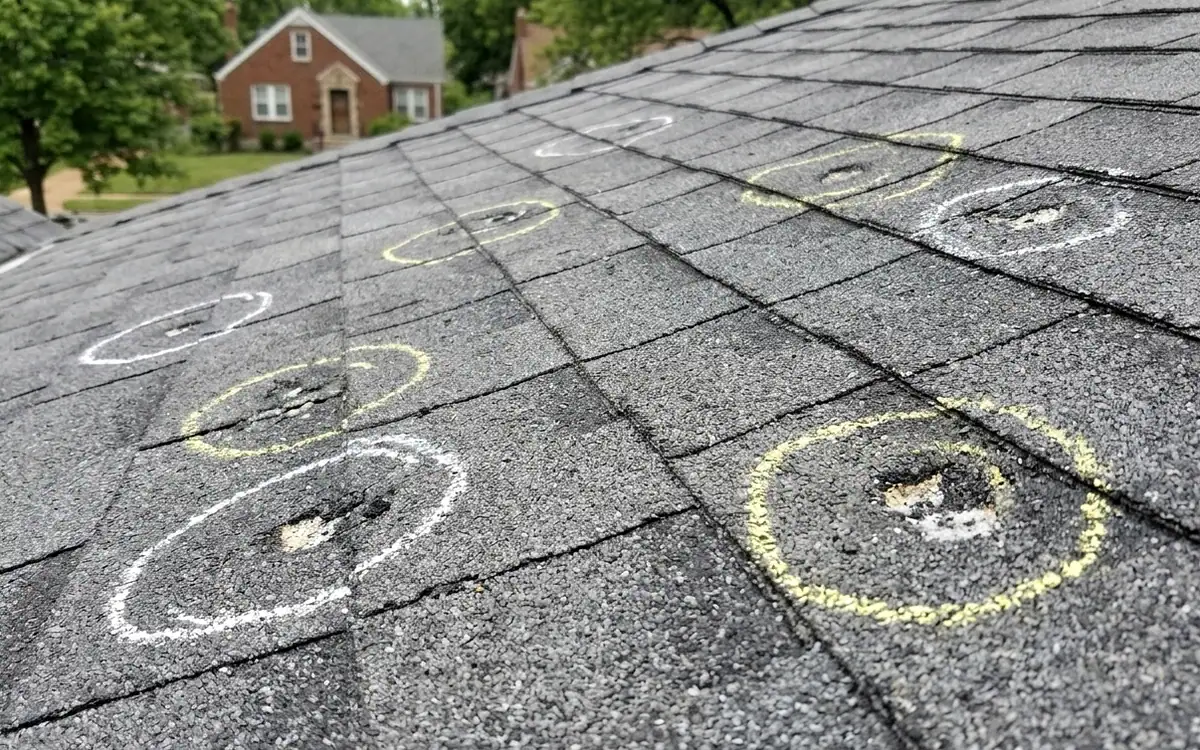
Hail damage roof repair addresses impact bruises, fractured shingle mats, and granule loss caused by hailstones. You need it after any spring storm with hail, even if nothing leaks. We count hits in test squares on each slope, check soft metals for dents, and repair or replace what the pattern of damage calls for.
How can you spot hail damage on a roof yourself?
Bright bare spots on shingles
Round spots where granules were knocked off show the dark asphalt underneath. They tend to line up on the slopes facing the direction the storm came from.
Soft, spongy bruises
A hail hit pressed gently with a fingertip should not give. If it feels like a bruised apple, the mat beneath has fractured even though the surface still looks whole.
Dimpled gutters and downspouts
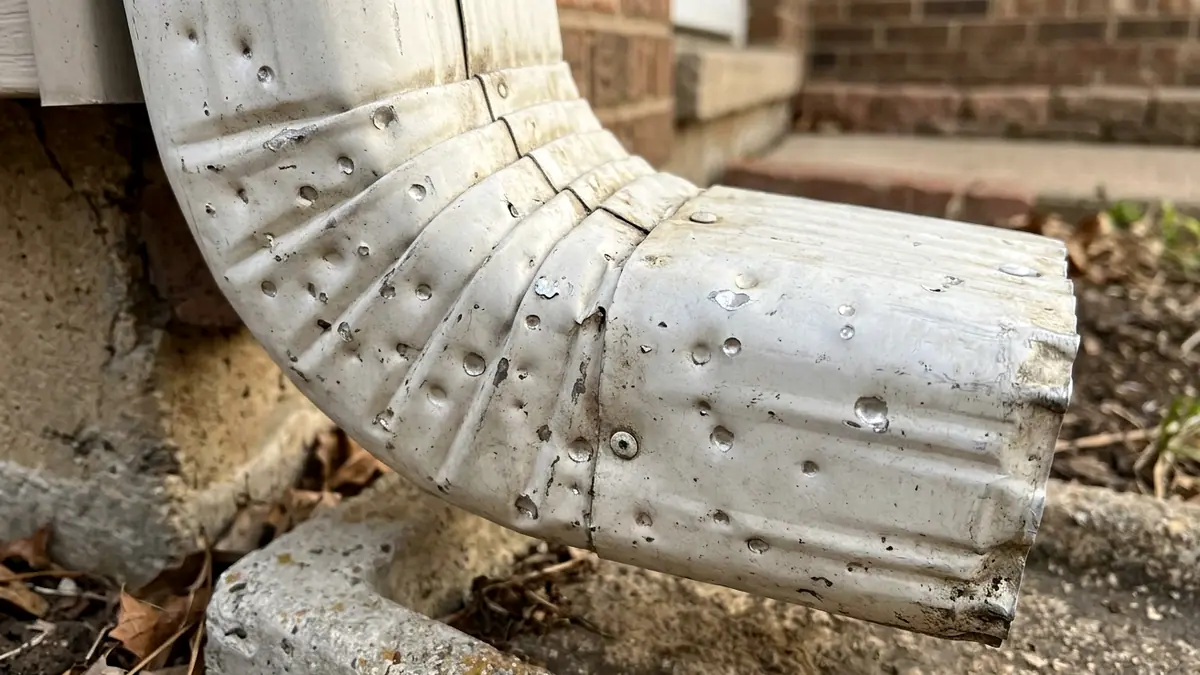
Hail leaves small round dents in soft metal. Check the ends of gutters, the downspouts, and the top panel of the garage door to judge how large the stones were.
Fresh spatter marks
Light spots on oxidized metal, fences, and deck boards mark where hail struck. They fade within a season, which makes them useful clues about when the storm happened.
Granules piling at downspouts
A fan of dark grit at the bottom of a downspout after a hail storm means the roof shed its protective surface. A few weeks of rain can wash a lot of it out.
Cracked plastic vents
Plastic roof vents and turbine caps crack under hail impact and leave a straight path for water. A split vent is a quick sign that the shingles nearby deserve a close look.
How we evaluate and repair a hail-hit roof
- 1
Test squares on each slope
We mark a ten-by-ten-foot area on every slope and count verified hail hits inside it. This gives a consistent number for each slope, instead of a general impression.
- 2
Check soft metals and vents
We examine gutters, downspouts, vents, flashing, and ridge caps for dents and cracks. Those collateral marks show the size and direction of the hail.
- 3
Mark and photograph hits
Each verified hit gets chalked and photographed, so you can see the bruise, the missing granules, and the placement for yourself, slope by slope.
- 4
Decide repair or replace by slope
A few scattered hits can usually be repaired. A dense pattern across a slope normally means replacing the slope. We explain which applies to each one.
- 5
Replace what failed
Damaged shingles, vents, and metal are replaced, and the surrounding courses are resealed. Granule debris is cleaned from the gutters so it does not clog the downspouts.
How we handle hail damage roof repair on St. Louis homes
A hailstone hitting an asphalt shingle can crush the fiberglass mat beneath the surface without cutting through. The spot feels slightly soft, and a bright circle shows where granules were knocked loose. Those granules shade the asphalt from the sun. Without them, the layer under the bruise ages quickly and cracks, which is why many hail-hit roofs only start leaking the following season.
We evaluate hail with test squares. On each slope we mark a ten-by-ten-foot area and count verified hits inside it. We press the bruises, look at how the granules scattered, and compare against collateral clues: dented gutters, pocked vents, and marks on the fascia and metal flashing. Together, they tell us the size of the hail, its direction, and which slopes took the worst of it.
The count drives the decision. A few scattered hits on one slope can often be repaired shingle by shingle. A dense pattern across a slope, especially on an older roof, usually calls for replacing that slope, because individual repairs would disturb brittle shingles around them. We lay out the numbers and photos so you can see the reasoning for yourself.
Why hail is a St. Louis roofing problem every spring
Hail is a regular feature of spring severe weather in the St. Louis area, and the season runs roughly March through June. Because storms track in narrow bands, one subdivision can take golf-ball stones while a few miles away only rain falls. That is why we inspect your roof directly instead of relying on what the news said happened across the metro, and we record what the stones actually did to your shingles.
The age and type of roof change how it takes a hit. Thin 3-tab shingles on 1990s homes in St. Charles County bruise more easily than heavier architectural shingles. Clay tile and slate on older south city homes crack outright. Metal roofs dent but rarely leak. Knowing the material tells us what damage to look for, what the hits mean for that roof, and what repair makes sense afterward.
Repair choices for a hail-hit roof
Spot shingle replacement
For a handful of verified hits on an otherwise healthy slope, we cut out and replace the bruised shingles one by one and hand-seal the new tabs.
Full slope replacement
When hits are dense, the slope is replaced from eave to ridge. A uniform new surface handles weather better than a patchwork of repairs on aging shingles.
Impact-resistant upgrade
Class 4 impact-resistant shingles use a tougher mat and a flexible coating that shrugs off smaller stones. They cost more, but they suit a hail-prone area.
Soft metal replacement
Dented vents, drip edge, and flashing are replaced as parts. They rarely leak right away, but dents weaken them and the next storm tends to finish the job.
What does hail damage roof repair cost in St. Louis?
Hail cost depends on how many slopes took damage and whether repair or replacement fits. A scattered-hit repair is a few hours of work. A slope replacement is a day or more and involves tear-off, underlayment, and new shingles. Pitch, height, and the number of vents and penetrations affect labor, and a thorough inspection with test squares is a modest cost that makes the decision clear.
Compare every roofing and siding price range or plan the order of your exterior work.
| Work | Typical range |
|---|---|
| Hail inspection with test squares | $135 to $385 |
| Spot repair of scattered hits | $395 to $985 |
| Replace vents and drip edge | $315 to $795 |
| Replace one hail-damaged slope | $2,140 to $5,230 |
These are typical St. Louis ranges for hail work, not a quote, and impact-resistant shingles add to the slope replacement figure.
Where we handle hail damage roof repair
The city, the counties and the towns below cover most of the homes we work on. If yours is not listed, call and ask.
- City of St. Louis 63102
- St. Louis County, MO 63105
- St. Charles County, MO 63301
- Florissant, MO 63031
- Chesterfield, MO 63017
- Oakville, MO 63129
- St. Charles, MO 63301
- O'Fallon, MO 63366
- St. Peters, MO 63376
- Kirkwood, MO 63122
- Mehlville, MO 63125
- Belleville, IL 62220
- University City, MO 63130
- Ballwin, MO 63011
- Wentzville, MO 63385
- Hazelwood, MO 63042
- Webster Groves, MO 63119
- Edwardsville, IL 62025
- Collinsville, IL 62234
- Alton, IL 62002
- O'Fallon, IL 62269
- Arnold, MO 63010
- Affton, MO 63123
- Jefferson County, MO 63050
Shingle, siding and window lines we install and repair around St. Louis include GAF, Owens Corning, CertainTeed and James Hardie, plus the other brands below.
- GAF
- Owens Corning
- CertainTeed
- IKO
- Atlas
- Malarkey
- James Hardie
- LP SmartSide
- Alside
- Mastic
- DaVinci
- Velux
- Carlisle
- Firestone
Hail Damage Roof Repair questions
How large does hail have to be to damage a St. Louis asphalt roof?
Damage often starts around one inch, roughly the size of a quarter, though it depends on shingle age, wind, and how fast the stones fell. Older, brittle shingles can bruise from smaller hail. Golf-ball stones and larger damage almost any asphalt roof.
Can I see hail bruises on my shingles from the ground?
Rarely. Bruises are small, round, and spread across the slope, and from the yard they blend into the texture. Dented gutters and downspouts are the easiest ground-level clue. Confirming shingle damage takes a walk across the roof and a hand on the surface.
What is a test square and why does a hail inspection use one?
A test square is a ten-by-ten-foot area on one slope where we count verified hail hits. Using the same size on every slope gives a fair comparison. The count helps decide whether a slope can be repaired or should be replaced.
Does hail damage show up months after the storm?
Yes. Granule loss exposes the asphalt to sun, and the fractured mat under a bruise cracks over time. A roof can look dry for a season and then leak at the same spots. That delay is why we recommend inspecting soon after a hail storm.
Should I choose Class 4 impact-resistant shingles when replacing hail-hit slopes?
They are worth considering in a hail-prone area. The tougher mat resists smaller stones and tends to hold up better over many springs. They cost more up front. We show you samples and explain the trade-off, so the choice rests on your roof and budget.
Related work we often pair with hail damage roof repair
Storm Damage Roof Repair
After the storm passes. A severe storm seldom hurts a roof in just one way.
Roof Insurance Claim Help
Roof damage, documented clearly. When storm damage may be covered, the roof evidence matters.
Hail Damage Siding Repair
Storm damaged siding. Spring hail leaves cracked vinyl, dented aluminum and bruised board on St.
Roof Replacement
Full tear-off, start to finish. A roof replacement strips the old covering down to the deck, repairs what is hiding underneath, and builds a new system on top.
Need hail damage roof repair in St. Louis?
Call any hour. A roofer answers, asks a few questions and sets up a visit.