Downspout and underground drain repair in St. Louis, MO
A gutter only works if the water has somewhere to go. We repair broken downspouts and buried drain lines so roof water leaves the house and stops pooling against the foundation or backing up into the gutter.
- Answered 24/7
- Gutters
- City, county and Metro East
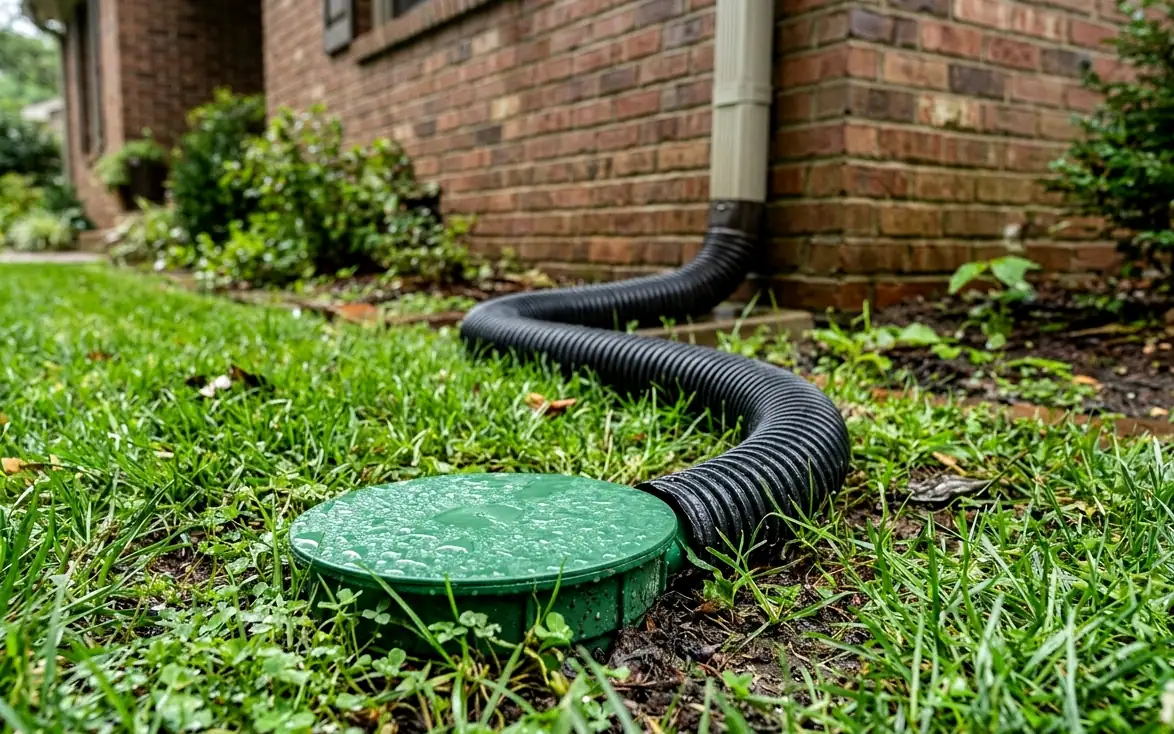
Downspout and underground drain repair covers broken, crushed or disconnected downspouts, clogged buried drain pipes, pop-up emitters, extensions and splash blocks, and grading at the outlet. You need it when gutters overflow despite being clean, or when water collects at the foundation. A visit starts by running water through the system.
How we handle downspout & underground drain repair on St. Louis homes
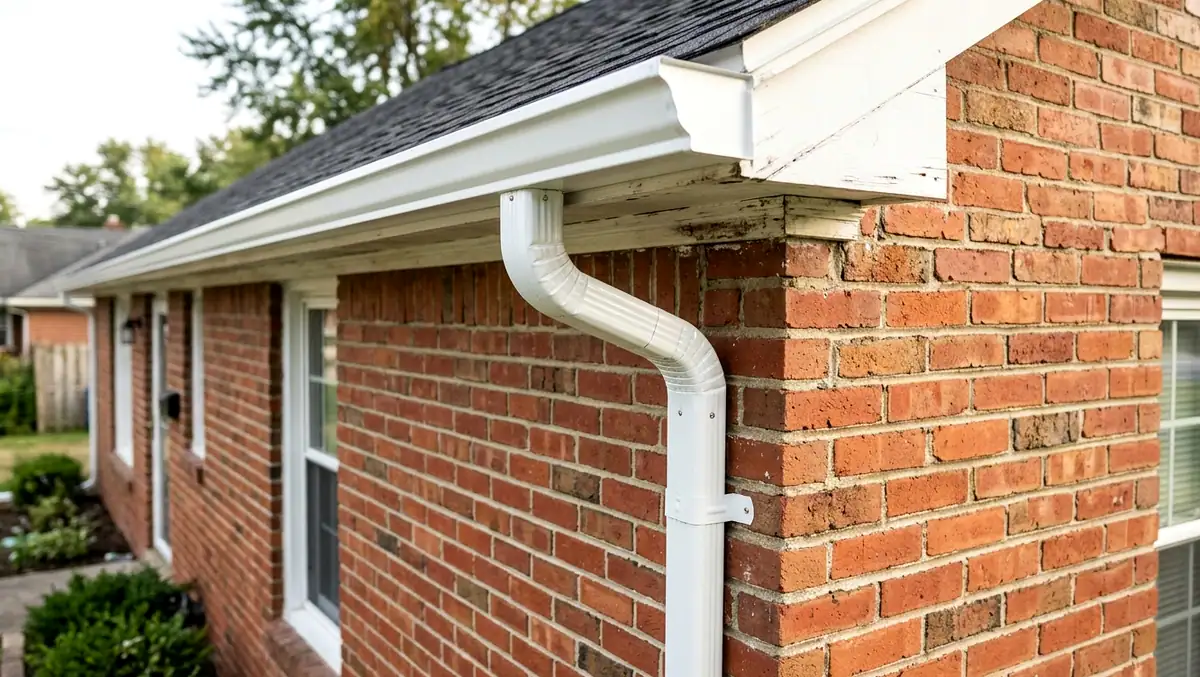
Most homeowners think of gutters as the whole system, but the pipes after them matter just as much. When a downspout is crushed by a mower, knocked loose by a ladder, or left ending right beside the wall, all of the water collected off the roof gets dumped where it does the most harm. That is how a clean, well-hung gutter still ends up soaking a basement wall.
Many houses send downspouts into buried pipe that runs out to the yard, the street or a low corner of the lot. Those lines clog with roots, silt and shingle grit, collapse where the pipe was thin, or crack when a tree root pushes through a joint. You rarely see the failure. You see the symptom: a gutter that overflows, a soggy patch, a puddle at the corner of the house.
We find where the water stops. A hose and a camera or probe tell us whether a line is blocked, broken or simply too flat. Then we repair the section, clear the run, add a proper outlet, or regrade the ground so the water keeps moving, and we flow-test it again before we leave.
Ways to move roof water away from the house
Extensions and splash blocks
Solid or flip-up extensions and concrete or plastic splash blocks carry water a few feet beyond the wall. Simple, low cost, and right for houses with enough yard slope.
Solid buried drain pipe
Smooth-wall PVC or similar pipe laid at a steady fall to a safe outlet. It resists crushing and roots far better than thin corrugated tubing.
Pop-up emitter
A buried line ending in a lid that opens under pressure and lies flat when dry. It keeps mowers clear and spreads water onto the lawn.
Regrading at the outlet
Reshaping soil so water runs away from the foundation and the outlet. Sometimes the whole fix is a few inches of fill and a shallow swale.
What does downspout and drain repair cost in St. Louis?
A loose elbow or a missing extension is a quick visit. Buried work is priced by how much ground we open, how deep the pipe sits, and whether we cross a walkway, a driveway or tree roots. A single crushed section is far less than a new run to the street or back yard. Material choice matters too, and rock or clay near the surface slows digging.
Compare every roofing and siding price range or plan the order of your exterior work.
| Work | Typical range |
|---|---|
| Replace a damaged downspout section and straps | $95 to $245 |
| Add extensions or splash blocks, per downspout | $65 to $185 |
| Clear a blocked underground line | $185 to $435 |
| Replace a crushed buried section with pop-up emitter | $465 to $1,285 |
These are typical St. Louis ranges for planning, not a quote, and pipe length, depth and surface restoration change the final price.
How we repair downspouts and underground drains
- 1
Trace every downspout outlet
We follow each downspout to where it ends, noting whether it goes to a buried pipe, a splash block, an emitter or the sewer cleanout, and flag anything that should not be connected.
- 2
Flow-test with a hose
Water goes in at the gutter outlet and we watch where it comes out and how fast. Slow flow, backups or missing output tell us which section of pipe is failing.
- 3
Clear or expose the bad section
Roots and silt are cleared when the pipe is sound. Where it is crushed or broken, we dig down to that section only and replace it, not the whole line.
- 4
Rebuild the outlet
The line ends in a pop-up emitter, a daylighted pipe or a solid extension, set at a gentle fall and away from the foundation and neighboring property.
- 5
Regrade and retest
We reshape soil at the outlet so water leaves rather than pools, put the lawn or mulch back, and run water through again to confirm the whole route works.
What tells you a downspout or buried drain has failed?
Gutter overflows when clean
If a freshly cleaned gutter still spills over the front in a moderate rain, the downspout or the buried line below it is probably clogged or collapsed.
Soggy spot near the corner
Ground that stays wet or sinks beside a downspout outlet, long after the rain, points to a leaking or broken underground pipe feeding water into one place.
Downspout dumping at the wall
A pipe that ends right at the foundation, or an extension that has gone missing, sends roof water straight toward the basement wall and the footing drain.
Crushed or kinked pipe
Dents from mowers, ladders or falling branches narrow the opening and catch debris. The pipe often looks fine from a distance until you see the pinch.
Gurgling or backing up
Water that bubbles out of a catch basin or a pop-up emitter, or comes back up through the downspout, shows a blockage downstream in the buried line.
Washed-out mulch and erosion
A trench worn into the soil, stained concrete or displaced stones at the outlet show where concentrated water has been hitting the ground repeatedly.
What drains and downspouts face in St. Louis yards
St. Louis soil is heavy clay in many neighborhoods, and it drains slowly. Water that lands near a foundation can sit there and press on basement walls through the spring storm season. Older city lots are narrow, so downspouts often end close to a neighbor's wall or a walkway, and buried pipes may run past mature trees whose roots find every joint. City brick houses also tend to have little room for a long surface run.
Many older houses have clay or cast iron lines that were installed when a downspout tied into the same underground system as other drainage. Homeowners should not route new downspouts into a sewer lateral, and local rules on disconnecting or redirecting downspouts vary by municipality, so it is worth checking with your city or village before changing where water goes. Newer subdivisions usually have corrugated pipe that crushes more easily.
Where we handle downspout & underground drain repair
The city, the counties and the towns below cover most of the homes we work on. If yours is not listed, call and ask.
- City of St. Louis 63102
- St. Louis County, MO 63105
- St. Charles County, MO 63301
- Florissant, MO 63031
- Chesterfield, MO 63017
- Oakville, MO 63129
- St. Charles, MO 63301
- O'Fallon, MO 63366
- St. Peters, MO 63376
- Kirkwood, MO 63122
- Mehlville, MO 63125
- Belleville, IL 62220
- University City, MO 63130
- Ballwin, MO 63011
- Wentzville, MO 63385
- Hazelwood, MO 63042
- Webster Groves, MO 63119
- Edwardsville, IL 62025
- Collinsville, IL 62234
- Alton, IL 62002
- O'Fallon, IL 62269
- Arnold, MO 63010
- Affton, MO 63123
- Jefferson County, MO 63050
Shingle, siding and window lines we install and repair around St. Louis include GAF, Owens Corning, CertainTeed and James Hardie, plus the other brands below.
- GAF
- Owens Corning
- CertainTeed
- IKO
- Atlas
- Malarkey
- James Hardie
- LP SmartSide
- Alside
- Mastic
- DaVinci
- Velux
- Carlisle
- Firestone
Downspout & Underground Drain Repair questions
Can I connect my downspouts to the sewer line to get rid of the water?
No, we advise against it. Roof water adds a heavy load to a sewer lateral and can cause backups, and many municipalities restrict it. We look for a safe daylight outlet in the yard instead. If the downspout is already tied in, we explain what we see so you can decide what to do.
How far from the foundation should a downspout discharge?
A good target is several feet beyond the wall, more if the lot slopes toward the house. Distance matters less than direction: the ground at the outlet must fall away from the foundation, and the water must not run onto a neighbor's property or a walkway.
Why does my underground drain work in light rain but back up in a storm?
A partial blockage, a sag that holds water, or a pipe that is too small will pass a trickle but choke on a surge. Roots entering a joint and clay silt are the usual causes. We flow-test at a heavy rate to find where the water slows.
Are corrugated black drain pipes okay to use?
They are cheap and flexible but crush under weight, trap silt in the ribs and sag over time. Smooth-wall rigid pipe moves water faster and clears more easily. For a line that has already failed once, we recommend solid pipe at a steady fall.
Do downspout repairs fix a wet basement?
They remove one common cause. When roof water dumps at the wall, the soil around the foundation stays saturated and water finds cracks. Sending that water several feet away often dries things out, though grading, window wells and groundwater can also play a part.
Related work we often pair with downspout & underground drain repair
Gutter Repair
Fix the gutter, not the symptom. A gutter that sags, drips at a seam or hangs by a few old spikes can often be saved.
Gutter Cleaning
Clear gutters, every season. St.
Seamless Gutters
New gutters, cut to fit. Seamless gutters are rolled from a coil of aluminum at your house, one continuous piece per run.
Box Gutter Repair & Relining
Built-in gutters, done properly. Box gutters hide inside the cornice where nobody sees them fail.
Need downspout & underground drain repair in St. Louis?
Call any hour. A roofer answers, asks a few questions and sets up a visit.