Flat roof repair in St. Louis for leaks, ponding and open seams
Most St. Louis flats keep their low-slope roof behind a brick parapet, which leaves water few ways out. We trace the leak to its real source and repair that spot, not just the stain on the ceiling below it.
- Answered 24/7
- Flat & Commercial Roofs
- City, county and Metro East
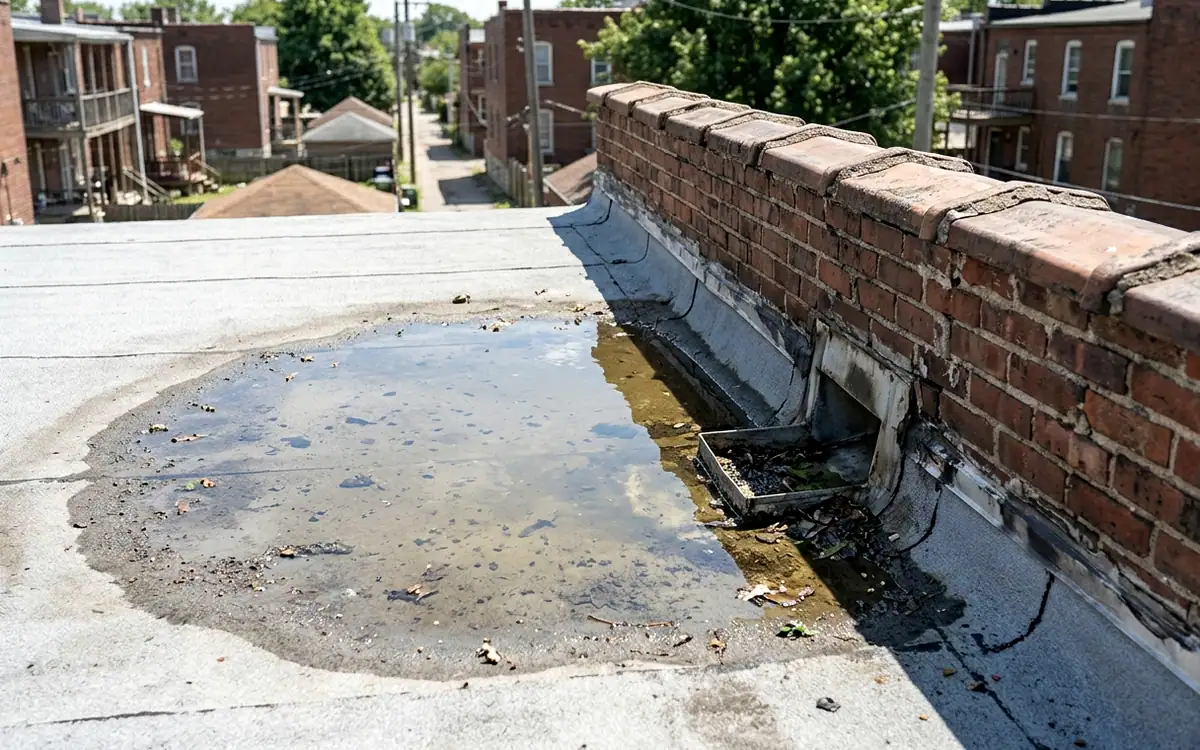
Flat roof repair fixes the spots where a low-slope roof lets water in: ponding areas, blisters, open seams, failed flashing, and clogged scuppers or box gutters. Call when a ceiling stains after rain or standing water lingers more than two days. We inspect the surface and parapet, explain what we find with photos, and repair the failed detail.
How do you know a flat roof needs repair?
Water stains on upper ceilings
Brown rings or bubbling paint on the top-floor ceiling, especially a day or two after rain, usually point to a membrane breach somewhere uphill of the stain, not directly above it.
Ponding that lasts for days
Standing water more than 48 hours after rain means the low spots are overloading the membrane. Algae rings, grit lines and a slimy film mark where the water sits longest.
Blisters and soft spots
Raised bubbles in the surface trap moisture or air under the membrane. A spongy feel underfoot suggests wet insulation, and a blister that has split is an open door for water.
Open or lifted seams
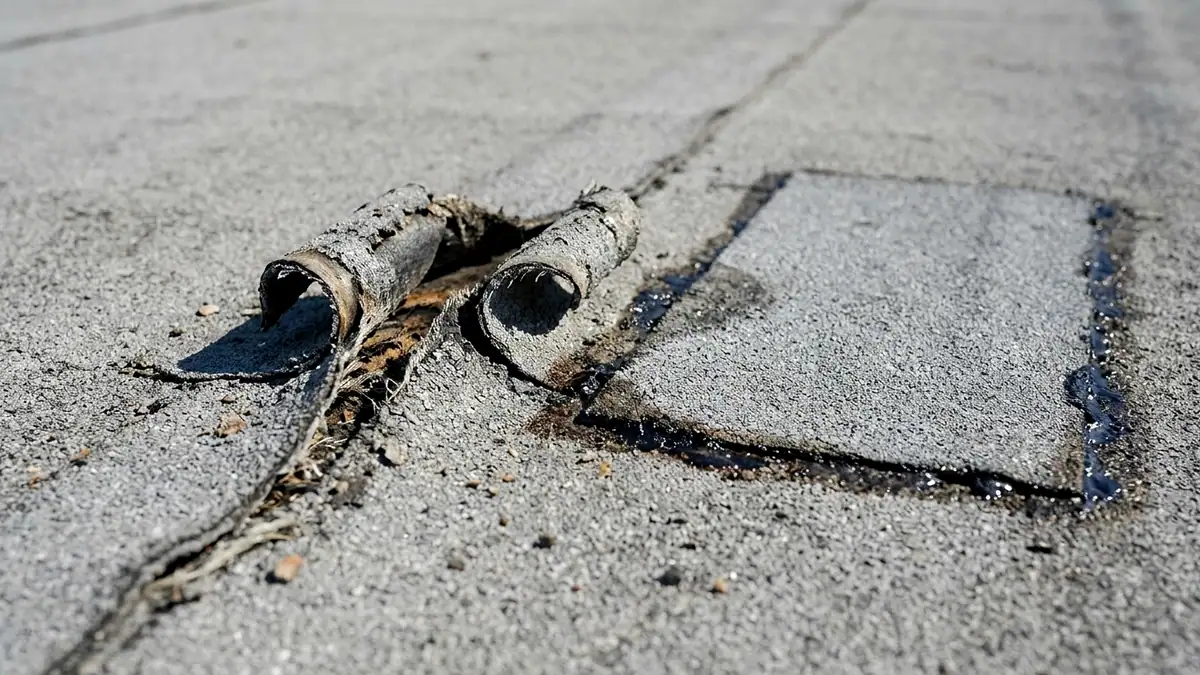
Look for membrane edges curling at laps, tar that has cracked and pulled away, or exposed fabric. Seams open first at corners and around vents, where the roof moves the most.
Cracked parapet caps and flashing
Brick parapets take freeze-thaw punishment. Loose coping, crumbling mortar and flashing that has pulled out of the wall let water run behind the membrane where you cannot see it.
Overflowing scuppers or box gutters
Water spilling over the parapet, rust streaks on the brick below, or a box gutter that stays full means the drain path is blocked or sagging and the roof edge is carrying the load.
What a flat roof repair visit looks like
- 1
Walk the roof and parapet
We start with the whole surface, low spots, seams, penetrations, scuppers and the inside face of the parapet, and note moisture clues on the ceiling below before touching anything.
- 2
Trace the water path
Leaks travel along decking and joists, so we follow stains uphill, check flashing heights, and probe suspect areas to find where water actually enters the roof assembly.
- 3
Show you the photos
We walk you through what we found with photos taken on the roof, mark each failed spot, and explain which problems are urgent and which can wait for a dry window.
- 4
Dry out and cut the repair
Failed membrane is cut back to sound material, wet debris and loose granules are cleared, and the substrate is dried so the new patch bonds instead of trapping moisture.
- 5
Patch, flash and seal edges
We install a compatible patch, add flashing or termination bar where the detail failed, clear scuppers and gutters, and water test critical corners before packing up.
How we handle flat roof repair on St. Louis homes
A flat roof is rarely truly flat. On a typical south city brick flat, the rear roof pitches a fraction of an inch per foot toward a scupper or a built-in box gutter, and every seam, curb and parapet edge is a place where that slow drainage can fail. When it does, water follows the brick and joists into a ceiling long before you see a drip on the roof itself.
Repair is the right call when the membrane is mostly sound and the damage is local. We find the failed detail, cut out the bad section, dry the substrate, and patch with a compatible material, whether that is a torch-applied modified bitumen patch, a TPO weld, an EPDM splice, or reinforced mastic at a flashing. Matching the patch to the existing membrane matters, because the wrong chemistry peels within a season.
We also tell you when repair stops making sense. If the insulation under the membrane is saturated, if blisters cover a large share of the surface, or if the same corner has been patched three times already, the money is better spent on a replacement plan. We say so plainly during the visit and explain why, so you are not paying for patches that cannot hold.
Why flat roof leaks are so common on St. Louis flats
The city's two-family and four-family brick flats were mostly built between 1900 and 1930 with a low-slope roof at the rear and a pitched front. The flat section drains through scuppers cut into the parapet or through a lined box gutter built into the cornice. Both are slow, narrow paths, and a few leaves, a pigeon nest or a sagging liner are enough to back water up onto the membrane and under the flashing.
Weather does the rest. Summer sun bakes dark membranes hot, then a thunderstorm drops the surface temperature in minutes. Winter freeze-thaw cycles pry at parapet mortar and widen the cracks that feed water behind the roof edge, and spring hail adds punctures and bruises. Because rowhouse roofs sit tight against neighbors, a repair also has to respect shared walls and tight access, often from the rear alley.
Repair methods we use on low-slope roofs
Membrane patch and weld
For TPO and PVC, we heat-weld a patch over cleaned, dry material. For EPDM, we use primer and splice tape. Both work only when the original membrane is still flexible.
Torch or cold-applied patch
Modified bitumen gets a granulated cap sheet patch lapped well past the damage, set with a torch or cold adhesive, depending on the building and what sits underneath.
Reinforced flashing repair
At parapets, curbs and pipes we embed fabric in sealant or replace the flashing, then terminate it with a metal bar so the top edge cannot peel away from the wall.
Scupper and box gutter rework
Failed scupper liners and cornice gutters are relined or rebuilt with new metal and sloped sealant, which stops the repeat leaks that patching only the field never cures.
What flat roof repair costs in St. Louis
Price depends on how many separate failures there are, how hard the roof is to reach, and how wet the layers underneath have become. A single seam or pipe boot is a short visit. A roof with several blisters, a damaged parapet cap and a failed scupper takes a full day, ladder or hoist staging for a rear roof, and sometimes a section of insulation. Access from the street versus an alley also changes the labor time.
Compare every roofing and siding price range or plan the order of your exterior work.
| Work | Typical range |
|---|---|
| Seam or pipe boot patch | $285 to $640 |
| Blister cut-out and patch, per area | $410 to $985 |
| Scupper or box gutter relining | $865 to $2,380 |
| Parapet flashing repair, rear roof | $1,140 to $3,260 |
These are typical St. Louis ranges for planning, not quotes, and the real number depends on what we find once we are on the roof.
Where we handle flat roof repair
The city, the counties and the towns below cover most of the homes we work on. If yours is not listed, call and ask.
- City of St. Louis 63102
- St. Louis County, MO 63105
- St. Charles County, MO 63301
- Florissant, MO 63031
- Chesterfield, MO 63017
- Oakville, MO 63129
- St. Charles, MO 63301
- O'Fallon, MO 63366
- St. Peters, MO 63376
- Kirkwood, MO 63122
- Mehlville, MO 63125
- Belleville, IL 62220
- University City, MO 63130
- Ballwin, MO 63011
- Wentzville, MO 63385
- Hazelwood, MO 63042
- Webster Groves, MO 63119
- Edwardsville, IL 62025
- Collinsville, IL 62234
- Alton, IL 62002
- O'Fallon, IL 62269
- Arnold, MO 63010
- Affton, MO 63123
- Jefferson County, MO 63050
Shingle, siding and window lines we install and repair around St. Louis include GAF, Owens Corning, CertainTeed and James Hardie, plus the other brands below.
- GAF
- Owens Corning
- CertainTeed
- IKO
- Atlas
- Malarkey
- James Hardie
- LP SmartSide
- Alside
- Mastic
- DaVinci
- Velux
- Carlisle
- Firestone
Flat Roof Repair questions
How long does a flat roof repair take on a St. Louis flat?
Most single repairs, such as a seam patch or a pipe flashing, take a few hours. A roof with multiple blisters, a damaged parapet cap and a clogged scupper usually takes a full day. Weather matters, since membranes need a dry surface to bond, so we plan the visit around a dry window whenever the leak allows.
Can you patch a flat roof in winter?
Yes, for emergency leaks. Cold stiffens membranes and adhesives, so we use cold-applied products rated for low temperatures, clear ice and snow first, and keep the patch small. It holds through the season, and we revisit the permanent repair in spring when warm, dry days let seams weld and bond fully.
Why does my flat roof leak only when it rains hard?
Heavy rain exposes drainage problems that light rain does not. Scuppers and box gutters that run full push water up the parapet wall and under flashing, and ponded water finds hairline cracks. If the leak shows only in storms, we check drainage capacity and flashing height before assuming the field membrane failed.
Is a blister on my flat roof an emergency?
Not usually. A blister that is intact and small can wait for a planned repair. A blister that has split, or one in a ponding area, should be fixed soon, since water enters the open edge and soaks the insulation. We check it with a probe and tell you which category yours falls into.
What if the roof under my parapet is too far gone to patch?
If wet insulation, widespread blisters or repeated failures show up, we explain it with photos and recommend a flat roof replacement instead. We do not push it. Sometimes a section replacement over the worst corner buys several years, and we describe that middle option too, with what each path would involve.
Related work we often pair with flat roof repair
Flat Roof Replacement
Tear-off and a new flat roof. When patches stop holding, a full replacement resets the whole low-slope roof.
Roof Flashing Repair
Flashing joint repair. Flashing is the thin metal and rubber that turns water away at every joint in a roof.
Roof Leak Repair
Find the real leak source. The stain on your ceiling is rarely under the hole in your roof.
Parapet Wall & Coping Repair
Seal the top of the wall. The short brick wall around a flat roof takes more weather than any other part of the building.
Need flat roof repair in St. Louis?
Call any hour. A roofer answers, asks a few questions and sets up a visit.