Flat roof replacement in St. Louis: tear-off and tapered insulation
When patches stop holding, a full replacement resets the whole low-slope roof. We strip to the deck, fix drainage with tapered insulation, and install a membrane matched to your building and your budget.
- Answered 24/7
- Flat & Commercial Roofs
- City, county and Metro East
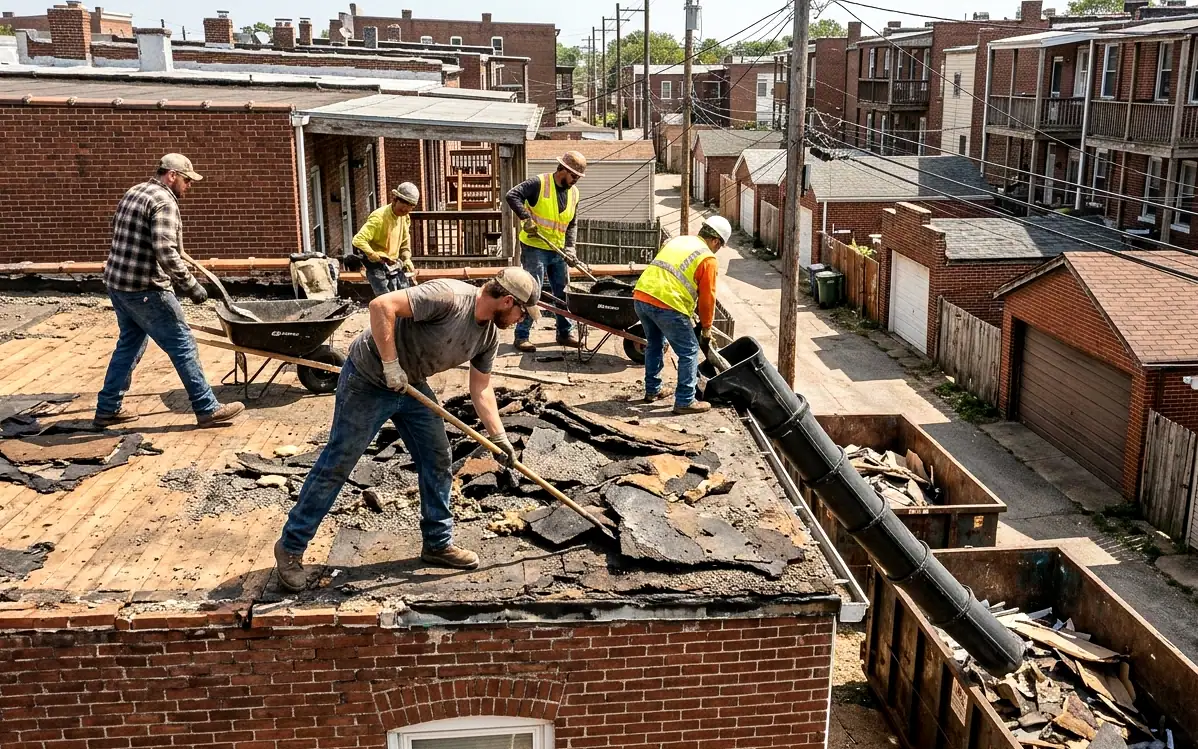
Flat roof replacement removes the old membrane and wet insulation down to the deck, repairs the structure, adds tapered insulation so water reaches the drains, and installs a new membrane with fresh flashing. You need it when moisture has soaked the layers or repairs keep failing. A visit covers measurements, core checks, a drainage plan and photos of what lies under your roof.
How we handle flat roof replacement on St. Louis homes
Replacing a flat roof is a bigger decision than replacing shingles, because the answer depends on what is already under the surface. Older St. Louis flats often carry two or three layers of built-up roofing, some of it hot-mopped decades ago, over wood fiberboard or perlite insulation that has absorbed water. Taking it all the way down to the deck is the only way to see the true condition of the joists and sheathing.
Tear-off versus recover is the first question. A recover, installing a new membrane over a sound existing one, saves disposal cost, but it works only when the old roof is dry, flat and already a single layer. We use a moisture scan and a few test cuts to find out, then tell you which route fits. Most roofs with saturated insulation need the full tear-off.
The second question is drainage. Flat roofs fail when water has nowhere to go, so we design the slope as part of the job. That means tapered insulation that pitches toward scuppers, drains or the box gutter, new sump pans where water collects, and flashing built high enough that a heavy storm cannot push over it. A permit is generally required in the city, and our crew handles the paperwork.
Membrane and insulation choices for a new flat roof
Tear-off with new membrane
The most reliable route. Everything above the deck is replaced, so there are no hidden wet layers, and you pick TPO, EPDM or modified bitumen on a clean, sloped surface.
Recover over a dry roof
A new membrane over one existing dry layer saves disposal and time. It is only suitable after a moisture scan confirms the old insulation is dry and the surface is flat.
Tapered insulation system
Pitched foam boards add slope and R-value in one step. Layout drawings show where crickets and saddles direct water around curbs, hatches and parapet corners to the drains.
New metal edge and coping
Fresh coping or edge metal on the parapet protects the weakest part of the roof edge and gives the membrane a clean, tight termination line.
What a flat roof replacement costs in St. Louis
Total cost follows roof size, the number of old layers to remove, the thickness of tapered insulation needed to move water, and the membrane you choose. A small rear roof on a two-family flat costs far less than a full four-family roof with several penetrations. Deck repairs are the main unknown, so we price the roof assuming sound decking and explain how rotted boards would change the number before any work starts.
Compare every roofing and siding price range or plan the order of your exterior work.
| Work | Typical range |
|---|---|
| Small rear roof, tear-off and membrane | $5,840 to $10,970 |
| Full two-family flat roof | $9,310 to $17,480 |
| Tapered insulation add-on, per roof | $1,620 to $4,350 |
| Deck repair allowance for rotted boards | $725 to $2,940 |
Ranges are typical for St. Louis planning, not quotes, and your final price depends on size, layers and what the deck reveals.
How a flat roof replacement runs, start to finish
- 1
Measure, core and scan
We measure the roof, cut a few test cores to count layers and check insulation moisture, and inspect the deck from the ceiling below when access allows.
- 2
Plan drainage and slope
We map low spots and drain locations, design the tapered insulation layout, and explain how scuppers, drains and flashing heights will change with the new system.
- 3
Tear off to the deck
Old membrane, wet insulation and loose flashing come off, debris is lowered into containers, and any rotted decking or damaged joists are replaced before new layers go on.
- 4
Insulate, slope and cover
Tapered insulation and cover board go down in staggered layers, fastened or adhered, and the roof is sealed in sections so a sudden storm never finds it open.
- 5
Install membrane and walk it
The membrane is installed, seams are welded or adhered, flashing is terminated at the parapet, and we walk the finished roof with you using photos of every detail.
When is it time to replace the whole flat roof?
Repairs keep failing nearby
If the same corner or seam has needed patching more than twice, the surrounding membrane has aged out. Fresh patches on brittle material peel at the edges within a season or two.
Insulation is wet underneath
A roof that feels spongy, or an infrared scan that shows wet insulation, means water is already inside the layers. Wet insulation loses its R-value and keeps the deck damp.
Widespread blisters and cracking
Blisters across large areas, alligator-style cracking and exposed reinforcing fabric show the surface has reached the end of its life and no longer sheds water.
Sagging deck or ponding zones
A roof that dips between joists collects water in the same places after every storm. Chronic ponding speeds up membrane wear and can point to rotted decking underneath.
Ceilings stain again and again
Multiple stains at different spots after each storm suggest failure across the roof, not at one detail. Chasing them with separate patches usually costs more than a new roof.
Layers piled up over decades
Two or three old roofs stacked together add heavy weight and hide rot. Once a roof reaches that point, a clean tear-off is safer than adding another layer on top.
Replacing flat roofs on St. Louis brick flats and rowhouses
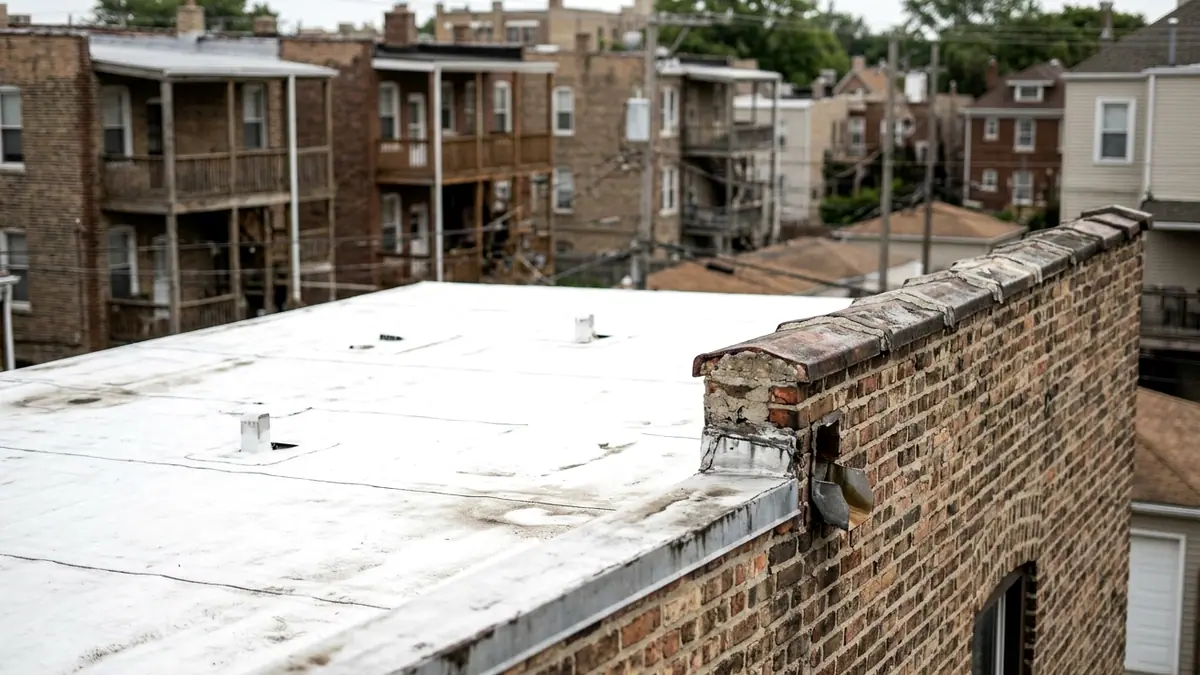
Many city flats have wood joists spanning from a brick party wall to the front wall, with plank or board decking that has been wet and dry through a hundred summers. Tear-off in this setting calls for care: crews stage materials through the alley or by hoist, protect the shared parapet, and check the joist ends where they sit in pockets in the brick, which is where rot hides most often.
Slope is the other local fact. Few of these roofs were framed with real pitch, so we build it back with tapered rigid insulation, often a quarter inch per foot, that turns a ponding roof into one that drains. Added insulation also helps with summer heat on top-floor units, and the winter heating load drops. Parapet height and scupper size decide how much insulation we can add before flashing heights become a problem.
Where we handle flat roof replacement
The city, the counties and the towns below cover most of the homes we work on. If yours is not listed, call and ask.
- City of St. Louis 63102
- St. Louis County, MO 63105
- St. Charles County, MO 63301
- Florissant, MO 63031
- Chesterfield, MO 63017
- Oakville, MO 63129
- St. Charles, MO 63301
- O'Fallon, MO 63366
- St. Peters, MO 63376
- Kirkwood, MO 63122
- Mehlville, MO 63125
- Belleville, IL 62220
- University City, MO 63130
- Ballwin, MO 63011
- Wentzville, MO 63385
- Hazelwood, MO 63042
- Webster Groves, MO 63119
- Edwardsville, IL 62025
- Collinsville, IL 62234
- Alton, IL 62002
- O'Fallon, IL 62269
- Arnold, MO 63010
- Affton, MO 63123
- Jefferson County, MO 63050
Shingle, siding and window lines we install and repair around St. Louis include GAF, Owens Corning, CertainTeed and James Hardie, plus the other brands below.
- GAF
- Owens Corning
- CertainTeed
- IKO
- Atlas
- Malarkey
- James Hardie
- LP SmartSide
- Alside
- Mastic
- DaVinci
- Velux
- Carlisle
- Firestone
Flat Roof Replacement questions
How long does a flat roof replacement take on a two-family flat?
A typical rear roof on a two-family flat takes one to three days, depending on layers, deck repairs and weather. Tear-off and drying-in happen on the same day so the roof is never left open overnight. Four-family buildings and roofs with many penetrations take longer, and we give you the working window at the start.
Do I need a permit to replace a flat roof in the city?
A permit is generally required for a full roof replacement in the City of St. Louis and in many county municipalities. Our crew handles the permit paperwork as part of the job, and the work is scheduled around inspections, so you do not need to chase approvals or visit any office yourself.
What is tapered insulation and why does my flat roof need it?
Tapered insulation is rigid foam cut in wedges so the roof surface slopes toward the drains instead of lying dead level. It removes ponding, which is what shortens membrane life. Without it, a new roof can start to collect water within a season, even if the membrane itself is excellent.
Can I stay in the building during flat roof tear-off?
Yes, in almost every case. Tear-off is loud for a few hours, and some dust can drift into attics or top-floor ceilings, so we advise covering furniture and removing wall hangings under the work area. We keep the roof dried in each day so rain never reaches the interior.
When is a recover better than a full tear-off?
A recover works when the existing roof is one layer, dry throughout, and still flat on the deck. A moisture scan and test cuts confirm that. Most older St. Louis flats fail the test because of saturated insulation or multiple layers, so a full tear-off ends up being the sound choice.
Related work we often pair with flat roof replacement
Flat Roof Repair
Low-slope roof leaks fixed. Most St.
TPO Roofing
Welded white flat roofing. TPO is a single-ply white membrane whose seams are welded with hot air into one continuous sheet.
EPDM Rubber Roofing
Adhered rubber flat roofing. EPDM is a flexible synthetic rubber sheet, glued down in large pieces with few seams.
Modified Bitumen Roofing
Layered cap sheet roofing. Modified bitumen is a layered asphalt roof, reinforced with polyester and finished with a granulated cap sheet.
Need flat roof replacement in St. Louis?
Call any hour. A roofer answers, asks a few questions and sets up a visit.