Parapet wall and coping repair in St. Louis brick buildings
The short brick wall around a flat roof takes more weather than any other part of the building. We repair the coping, the mortar and the flashing so water stops entering from the top.
- Answered 24/7
- Flat & Commercial Roofs
- City, county and Metro East
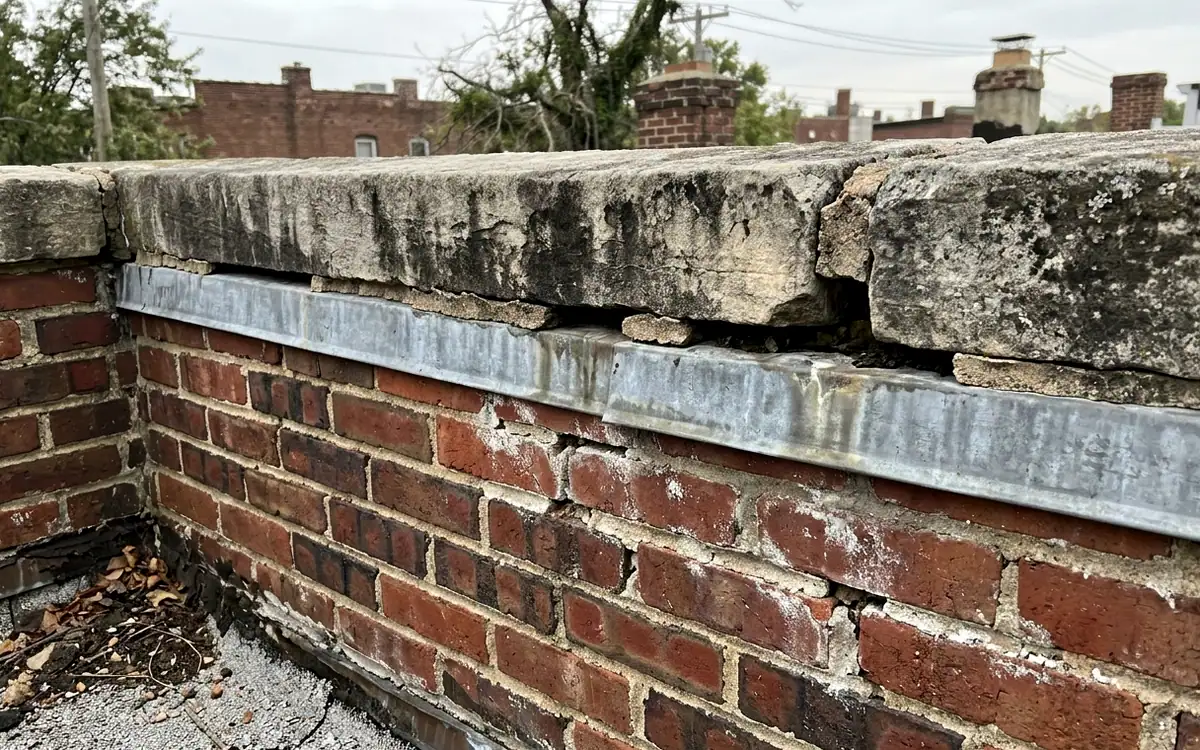
Parapet wall and coping repair fixes the cap, mortar joints, counterflashing and membrane flashing along the short wall at a roof edge. You need it when coping stones crack or shift, mortar crumbles, or stains appear on walls and ceilings below. We inspect the wall from the roof, mark each opening, and repair from the top down.
How we handle parapet wall & coping repair on St. Louis homes
A parapet is the low wall that rises above the roofline on brick flats, rowhouses and storefronts. It hides the roof, blocks fire from jumping between buildings and gives the facade a clean top edge. It also stands in the weather on three sides, with rain hitting both faces and the top, which makes it one of the most leak-prone parts of an old St. Louis building.
Water gets in at four places. The coping on top, whether cut stone, terra cotta, cast stone or a metal cap, cracks or shifts and opens its joints. The mortar below it erodes. The counterflashing meant to shed water over the roof membrane pulls out of its slot, called a reglet. And the membrane flashing that climbs the inside face of the wall dries out, splits or peels away from the brick.
The damage often shows up far from the cause. A parapet can soak up water for a whole season before it appears as peeling paint, efflorescence, a bulging plaster patch or a stained ceiling one floor below. That is why we repair from the top of the wall down, treating coping, mortar, reglet and flashing as one assembly instead of fixing only the spot where the stain appeared.
What repair choices exist for a parapet?
Repoint and reset coping
If the stone or terra cotta caps are still sound, they are lifted, rebedded and pointed. It keeps the original look and works well on historic fronts.
Replace damaged coping units
Broken pieces are swapped with matching stone, cast stone or terra cotta where available. Joints get flexible sealant so the cap can move with the seasons.
Metal coping cap system
A formed aluminum or steel cap with a sloped top and drip edge covers the entire wall. It is a clean, durable choice when the original stone is beyond repair.
Rebuild the top courses
Where several courses are loose or saturated, we take them down, rebuild with sound brick and mortar, and put new coping and flashing on top of a stable base.
What does parapet and coping repair cost in St. Louis?
Price depends on how much of the wall is affected, the height of the parapet and what the coping is made of. Cut stone and terra cotta cost more to reset or replace than a metal cap. Repointing is billed by the foot, and rebuilding courses takes more time and materials. Access from an alley or rear roof, scaffolding needs and shared walls with a neighbor also affect the final number.
Compare every roofing and siding price range or plan the order of your exterior work.
| Work | Typical range |
|---|---|
| Repoint parapet mortar joints, per foot | $19 to $47 |
| Reset or replace coping stones, per section | $286 to $842 |
| Metal coping cap installed, per linear foot | $34 to $78 |
| Reglet and counterflashing rework, per wall | $968 to $2,347 |
These 2026 St. Louis ranges are typical planning figures, not quotes, and the true cost depends on what we find under the cap and in the joints.
How we repair a parapet wall and coping
- 1
Survey the whole wall top
We walk the roof edge, sight along the coping for shifts, probe the mortar, tap suspect bricks and check the reglet, counterflashing and inside-face flashing for gaps.
- 2
Mark every opening
Each cracked stone, open joint and lifted flashing is marked and photographed. We walk you through the photos so you can see which are urgent and which can wait for a dry week.
- 3
Repoint and reset masonry
Loose mortar is ground out, bricks are reset, and new mortar is packed in a type compatible with old brick. Coping stones are lifted, cleaned and bedded again with fresh joints.
- 4
Replace caps and counterflashing
Broken coping is replaced or covered with a sloped metal cap. New counterflashing is set into a clean reglet and sealed, so it overlaps the base flashing as designed.
- 5
Rework wall flashing and test
The membrane flashing on the inside face is repaired or replaced with a proper termination at the top. We check the roof surface for ponding near the wall and clear scuppers.
What does a failing parapet wall look like?
Cracked or shifted coping
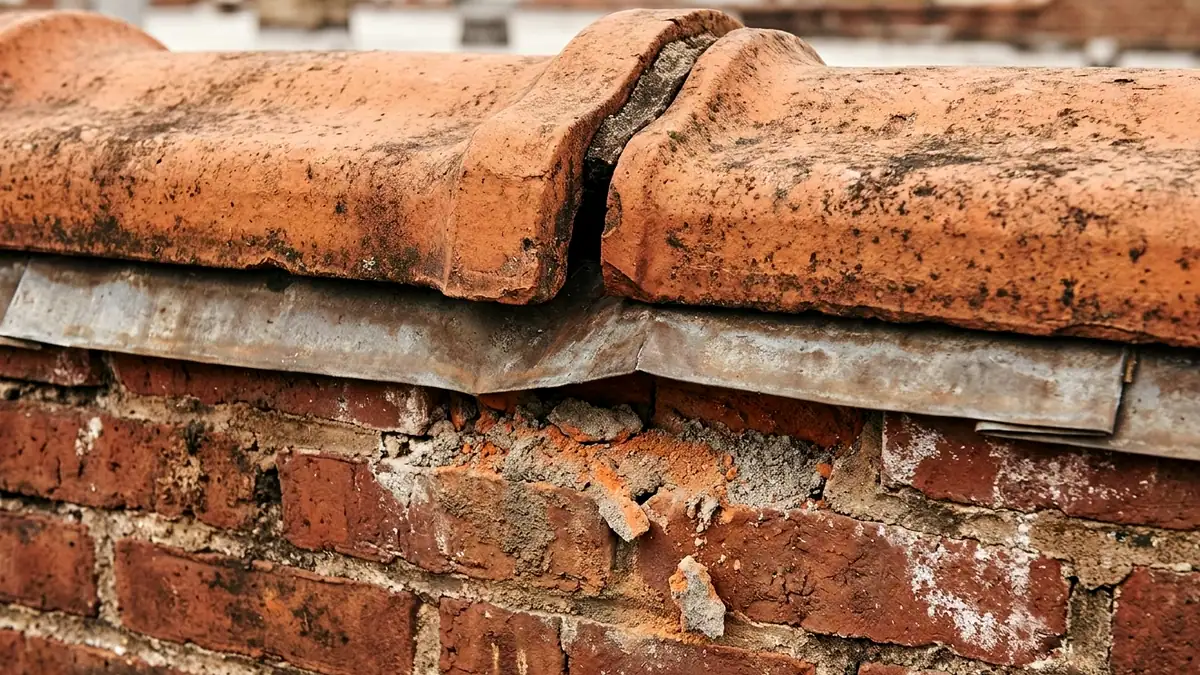
Stone or terra cotta caps with open joints, broken corners or visible gaps along the wall top let rain drop straight into the core of the brick wall beneath them.
Sandy, missing mortar joints
Joints that rake back an inch or crumble under a screwdriver no longer shed water. Bricks near the top may rock loose, and water follows the gaps into the wall.
White crust on the brick
Powdery white salt, called efflorescence, on the face or inside of the parapet is a sign that water is moving through the masonry and drying out at the surface.
Flashing peeling off the wall
Membrane or metal flashing that sags, curls or has gaps along the inside face leaves a clear path for water to run behind the roof edge and into the building.
Damp plaster below the roof
Stained plaster, flaking paint or bubbled wallpaper on the top-floor exterior walls often comes from the parapet above, not the roof surface or a window.
Bulging or leaning brick
A parapet face that bows outward, or shows stair-step cracks near corners, has been wet and frozen many times. It needs attention before bricks work loose and fall.
Why St. Louis parapets take such a beating
Brick flats, rowhouses and corner storefronts across Soulard, Benton Park, The Hill and south city were built with parapets, often topped with stone or terra cotta coping from the original builder. Many are shared party walls, so one building's failed cap can wet its neighbor's plaster. A century of rain, ice and previous repairs has left a patchwork of mortar types, caulk lines and tar smears along the top of the wall.
Freeze-thaw is the biggest local factor. Water that enters a joint in January freezes and expands, pushing the coping out of line and opening the next gap. Summer heat then bakes the dark flashing and cracks the sealant. The parapet is also exposed to wind from the river side and to storm debris. Access is often from an alley or the roof next door, so we plan ladders and staging carefully.
Where we handle parapet wall & coping repair
The city, the counties and the towns below cover most of the homes we work on. If yours is not listed, call and ask.
- City of St. Louis 63102
- St. Louis County, MO 63105
- St. Charles County, MO 63301
- Florissant, MO 63031
- Chesterfield, MO 63017
- Oakville, MO 63129
- St. Charles, MO 63301
- O'Fallon, MO 63366
- St. Peters, MO 63376
- Kirkwood, MO 63122
- Mehlville, MO 63125
- Belleville, IL 62220
- University City, MO 63130
- Ballwin, MO 63011
- Wentzville, MO 63385
- Hazelwood, MO 63042
- Webster Groves, MO 63119
- Edwardsville, IL 62025
- Collinsville, IL 62234
- Alton, IL 62002
- O'Fallon, IL 62269
- Arnold, MO 63010
- Affton, MO 63123
- Jefferson County, MO 63050
Shingle, siding and window lines we install and repair around St. Louis include GAF, Owens Corning, CertainTeed and James Hardie, plus the other brands below.
- GAF
- Owens Corning
- CertainTeed
- IKO
- Atlas
- Malarkey
- James Hardie
- LP SmartSide
- Alside
- Mastic
- DaVinci
- Velux
- Carlisle
- Firestone
Parapet Wall & Coping Repair questions
What is a reglet and why does it matter on a parapet?
A reglet is a narrow groove cut into the brick or mortar to hold the top edge of counterflashing. It lets metal tuck into the wall so water runs over the joint, not behind it. If the reglet is crumbled or packed with old caulk, the flashing can pull loose and leak.
Can cracked terra cotta coping be repaired or must it be replaced?
Hairline cracks and open joints can usually be repaired with compatible mortar or sealant after cleaning. If pieces are broken, spalled or no longer sit level, replacement is better. Matching terra cotta is hard to find, so a metal cap over the old units is sometimes the practical option.
Why do my top-floor walls stain when the roof itself is dry?
A parapet can hold water inside the brick, then release it slowly into the plaster below. The stain appears on the wall, not the ceiling, and often lags behind the rain by days. We check coping, mortar and inside-face flashing before assuming the field of the roof is leaking.
Do I need scaffolding to repair my parapet?
Usually not for a one or two story building. Most parapet work is done from the roof side, with ladders and fall protection. Taller facades, storefront fronts or work on the street face of the wall may call for a lift or staging, which we plan before the day of the repair.
Should I fix the parapet before or during a flat roof replacement?
During is best. The membrane flashing climbs the inside face of the wall, so repointing, reglets and coping need to be sound before the new roof is installed. Doing both together avoids tearing fresh flashing apart later and gives the new roof a clean, dry termination line.
Related work we often pair with parapet wall & coping repair
Flat Roof Repair
Low-slope roof leaks fixed. Most St.
Roof Flashing Repair
Flashing joint repair. Flashing is the thin metal and rubber that turns water away at every joint in a roof.
Flat Roof Replacement
Tear-off and a new flat roof. When patches stop holding, a full replacement resets the whole low-slope roof.
Commercial Roofing
Small commercial roof work. We handle roofs on small commercial buildings, corner storefronts and multi-unit apartment buildings across the St.
Need parapet wall & coping repair in St. Louis?
Call any hour. A roofer answers, asks a few questions and sets up a visit.