Seamless gutters in St. Louis: 5 inch and 6 inch K-style aluminum
Seamless gutters are rolled from a coil of aluminum at your house, one continuous piece per run. With no joints along the length, there are far fewer places for a leak to start.
- Answered 24/7
- Gutters
- City, county and Metro East
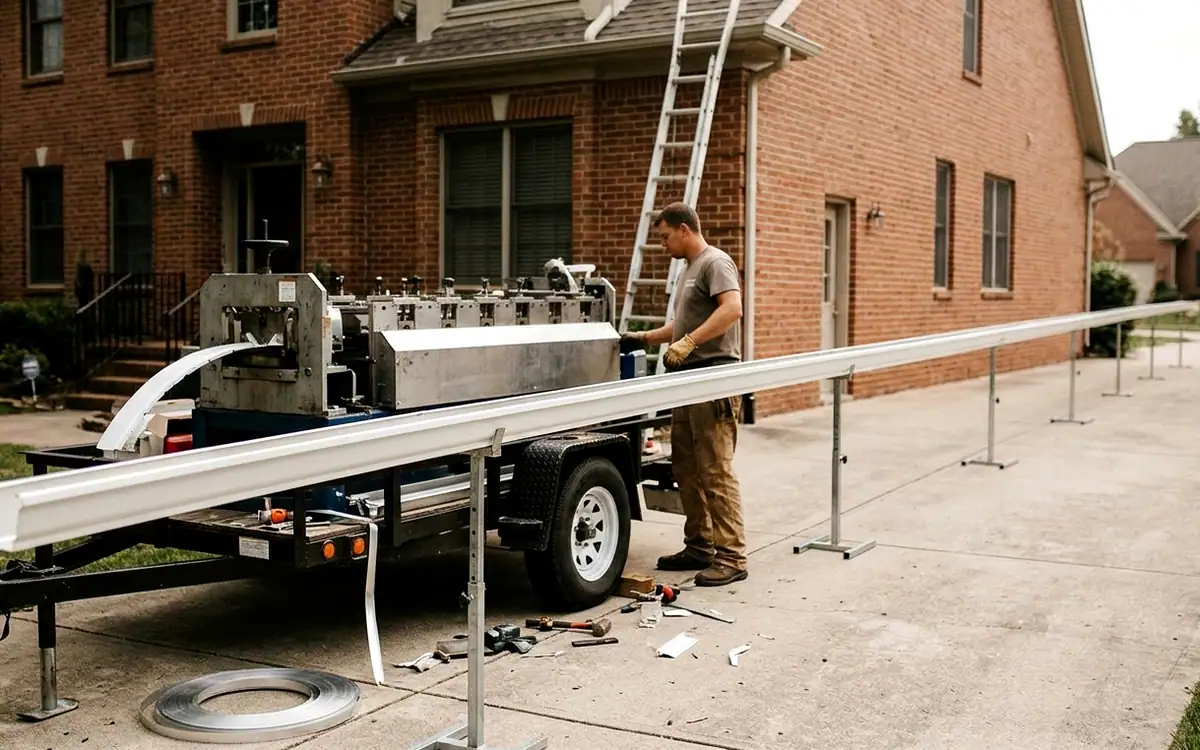
Seamless gutters are K-style aluminum troughs, 5 inch or 6 inch, rolled from coil on site so each run is a single piece cut to the exact length of your roofline. Only the corners and end caps are sealed. Choose them for a new install, an added section, or a house where sectional gutters keep dripping at the seams.
How we handle seamless gutters on St. Louis homes
Sectional gutters come in ten-foot pieces joined by sealant or rivets, which means a seam every few feet. Each seam is a spot where sealant dries, shifts, and starts to drip. A seamless run avoids that. Our crew brings a roll-forming machine and a coil of aluminum to your driveway and forms the gutter right there, matched to the actual length of each fascia board.
The profile is K-style, which looks like crown molding from the street and holds more water than a basic half-round. We roll it in two sizes. Five inch is the usual choice for most roofs. Six inch carries around a third more water and suits larger roofs, steep pitches, and homes under heavy tree cover where a downpour dumps quickly onto a long slope.
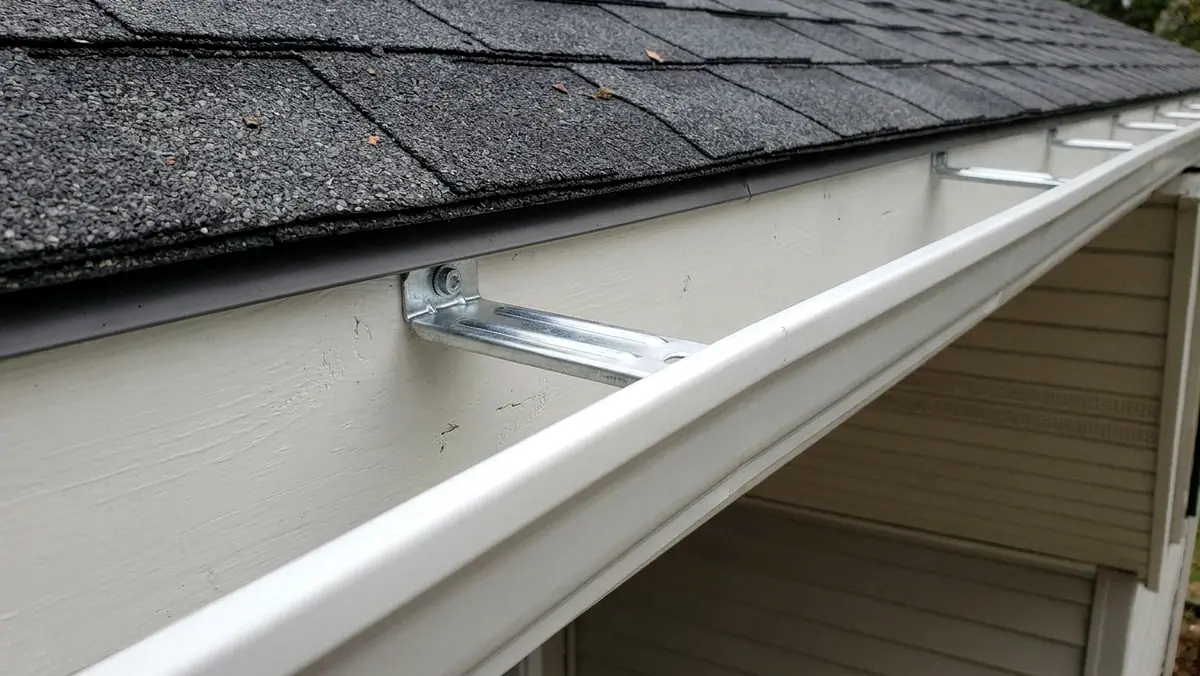
Aluminum is lightweight, will not rust, and comes in baked-on colors that match trim and brick. We hang the gutters with hidden hangers spaced closely, pitch them toward the downspouts, and seal the corners and end caps. Downspouts are sized and placed to move water away from the foundation, not just off the roof.
Sizing and finish choices for new seamless gutters
5 inch K-style aluminum
The standard size for most St. Louis houses. It handles ordinary rain on an average roof and pairs with 2 by 3 inch downspouts.
6 inch K-style aluminum
A wider trough with more capacity for large roofs, steep pitches and tree-covered lots. It usually pairs with larger 3 by 4 inch downspouts.
Heavier gauge aluminum
Thicker material that resists dents from ladders, hail and heavy ice. It costs more but holds its shape longer on exposed runs.
Color-matched baked finish
Factory-coated aluminum in white, brown, black, gray and other shades, selected to complement brick, trim and siding, with matching downspouts and accessories.
What do seamless gutters cost in St. Louis?
Most gutter work is priced per linear foot, with extras for corners, downspouts and difficult access. A single-story ranch with simple rooflines costs less per foot than a three-story house that needs tall ladders or lifts. Six inch gutters and heavier gauge aluminum cost more than 5 inch standard. Removal of old gutters, fascia repair, and any special downspout drainage are quoted separately from the new gutter run.
Compare every roofing and siding price range or plan the order of your exterior work.
| Work | Typical range |
|---|---|
| 5 inch seamless aluminum, per linear foot | $9 to $14 |
| 6 inch seamless aluminum, per linear foot | $11 to $17 |
| Downspout, each, installed | $24 to $47 |
| Typical whole-house install, ranch size | $1,485 to $2,965 |
Ranges are typical for St. Louis planning and not a quote, and roofline length, height and access will shift the total.
How we roll and hang seamless gutters
- 1
Measure every roofline
We measure each fascia run, count corners, and note roof pitch, valleys and where water naturally concentrates. That sets the size, run lengths and downspout locations.
- 2
Roll the gutter on site
The machine feeds aluminum coil and forms a K-style trough to the exact length needed. No joints are introduced along the run, only at corners and end caps.
- 3
Cut and seal corners
Inside and outside corners are mitered, riveted and sealed with gutter-grade sealant. End caps are fixed in place and sealed before the run is lifted into position.
- 4
Hang with hidden hangers
Runs are fastened to the fascia with hidden hangers into solid wood, set with a subtle pitch toward each outlet. We check that the drip edge directs water into the trough.
- 5
Install downspouts and test flow
Downspouts are connected, strapped to the wall, and finished with extensions or splash blocks. We run water through the system to confirm that it drains and no seam weeps.
When do new seamless gutters make sense?
Your house has no gutters
Water pouring from the roof edge erodes beds, splashes siding, and pools near the foundation. A new system gives it a controlled path away from the house.
Seams drip in every rain
Sectional gutters leak at their joints as sealant ages. If you keep resealing seams, running seamless gutters removes most of those trouble spots.
Gutters overflow in heavy rain
Water coming over the front edge during a downpour often means the trough is too small. Moving from 5 inch to 6 inch gives it room.
You are re-roofing or re-siding
New fascia and a new roof edge are the best time to hang new gutters, since the surfaces are fresh and the drip edge and flashing can be coordinated.
You added a room or porch roof
An addition changes how water runs off the house. New seamless runs can be tied to the existing system and downspouts relocated for the new layout.
The existing color is faded
Chalky, faded or stained gutters make a house look tired. New baked-on aluminum in a matching color changes the look of the entire front elevation.
Seamless gutters for St. Louis houses and storms
St. Louis gets intense downpours in spring and early summer, and a roof can shed an astonishing volume in minutes. That is why we often recommend 6 inch gutters and larger downspouts for houses with long, steep roof planes, common on county ranches and newer two-story homes in St. Charles County. The extra capacity keeps water from sheeting over the edge and splashing foundation plantings.
Seasons matter too. Aluminum expands and contracts through our freeze-thaw winters and hot, humid summers, which is another reason continuous runs hold up better than rows of joints. Under oaks, maples and sweetgums, gutters collect debris, so good pitch and properly placed downspouts matter. Many city brick homes have built-in box gutters, which are a different job and covered on our gutter replacement page.
Where we handle seamless gutters
The city, the counties and the towns below cover most of the homes we work on. If yours is not listed, call and ask.
- City of St. Louis 63102
- St. Louis County, MO 63105
- St. Charles County, MO 63301
- Florissant, MO 63031
- Chesterfield, MO 63017
- Oakville, MO 63129
- St. Charles, MO 63301
- O'Fallon, MO 63366
- St. Peters, MO 63376
- Kirkwood, MO 63122
- Mehlville, MO 63125
- Belleville, IL 62220
- University City, MO 63130
- Ballwin, MO 63011
- Wentzville, MO 63385
- Hazelwood, MO 63042
- Webster Groves, MO 63119
- Edwardsville, IL 62025
- Collinsville, IL 62234
- Alton, IL 62002
- O'Fallon, IL 62269
- Arnold, MO 63010
- Affton, MO 63123
- Jefferson County, MO 63050
Shingle, siding and window lines we install and repair around St. Louis include GAF, Owens Corning, CertainTeed and James Hardie, plus the other brands below.
- GAF
- Owens Corning
- CertainTeed
- IKO
- Atlas
- Malarkey
- James Hardie
- LP SmartSide
- Alside
- Mastic
- DaVinci
- Velux
- Carlisle
- Firestone
Seamless Gutters questions
Are seamless gutters really seamless all the way around?
The long straight runs are one continuous piece, but corners, end caps and downspout outlets still have joints, and those are sealed. The big gain is that the many mid-run seams of sectional gutters are gone, which removes the most common source of drips along the length.
Should I choose 5 inch or 6 inch gutters?
Five inch works for many average roofs. Six inch is smart for larger roof areas, steep pitches, valleys that dump water in one spot, and lots with heavy tree cover. We look at your roof layout and tell you which one fits, since downspout size matters as much as trough width.
What are seamless gutters made of?
We roll them from aluminum coil. It is light, resists rust, and takes a baked-on color finish that holds up in St. Louis sun and winter. Steel and copper exist, but aluminum is the practical choice for most homes and fits the on-site forming process.
How long does it take to install seamless gutters on a house?
Most houses are done in a day, with larger or multi-story homes sometimes running longer. Forming happens in the driveway, so there is no waiting on a shop. Weather and the condition of the fascia board can affect the schedule.
Do new gutters need a particular slope?
Yes, a slight, steady pitch toward the downspout outlet so water keeps moving instead of pooling. Too little and standing water collects; too much looks crooked from the street. We set it carefully and test with water before we leave.
Related work we often pair with seamless gutters
Gutter Replacement
Out with the old gutters. Some gutters are past patching.
Gutter Guards
Fewer clogs, fewer ladder trips. Gutter guards keep leaves and debris out of the trough so water can flow.
Soffit & Fascia Repair
Roof edge trim repair. The soffit and fascia close the edge of your roof, keep out birds and wasps, and carry your gutters.
Downspout & Underground Drain Repair
Carry the water away for real. A gutter only works if the water has somewhere to go.
Need seamless gutters in St. Louis?
Call any hour. A roofer answers, asks a few questions and sets up a visit.