Chimney flashing repair in St. Louis, MO for brick chimneys
Where a brick chimney meets the roof, water has four sides to get in from. Step flashing, counter flashing, and a back saddle must all work together, and old St. Louis chimneys often have none that do.
- Answered 24/7
- Roof Repair
- City, county and Metro East
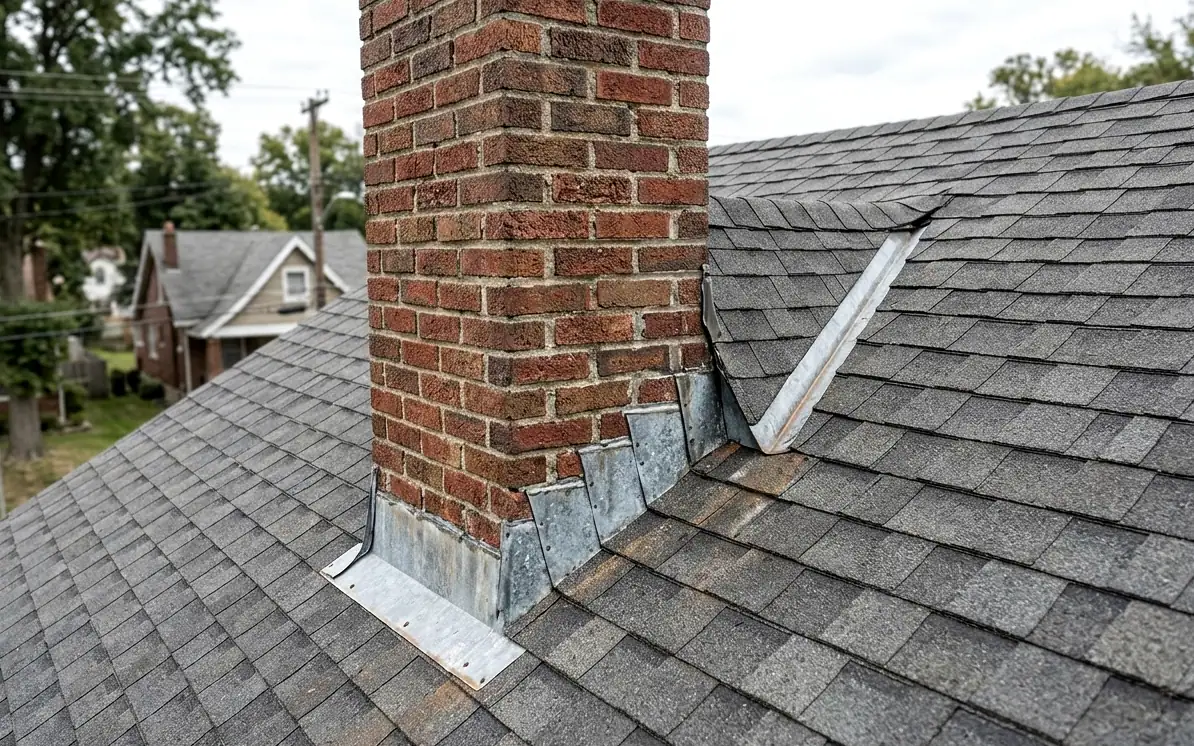
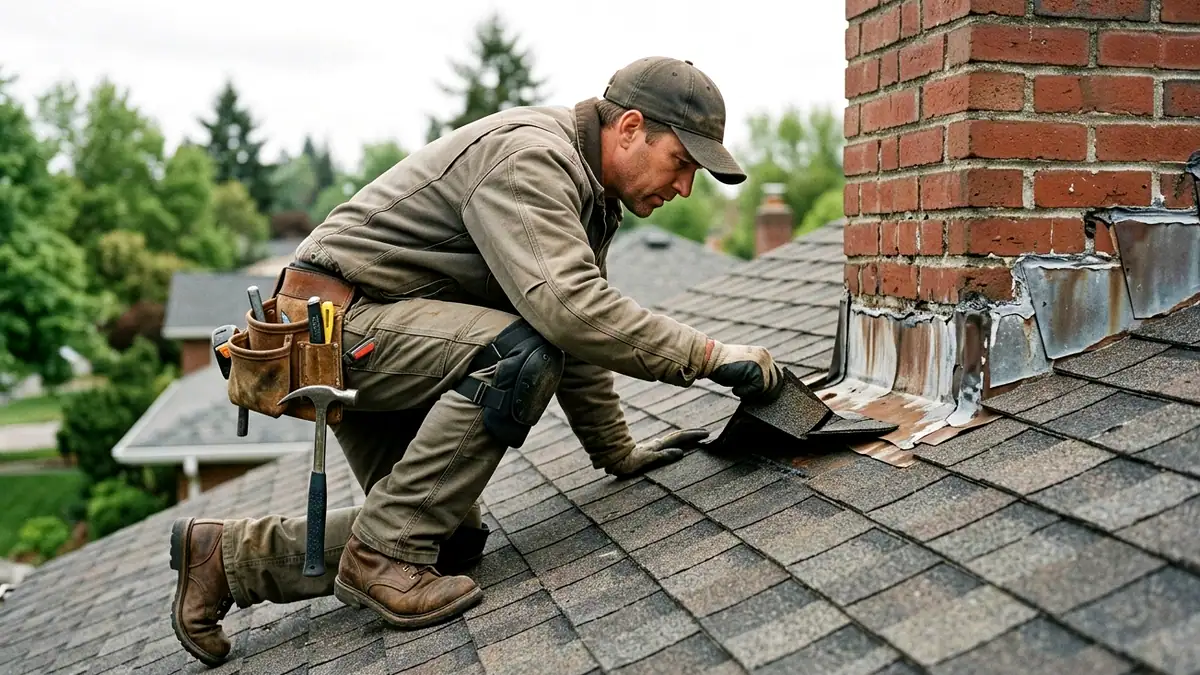
Chimney flashing repair replaces the layered metal that seals a brick chimney where it passes through the roof. You need it when stains appear near the chimney, mortar crumbles at the metal, or caulk has cracked. We cut counter flashing into the mortar joints, install step flashing and a back saddle, and seal the top edge.
How we handle chimney flashing repair on St. Louis homes
Chimney flashing is a two-part system. Step flashing is bent metal woven into the shingles along the sides of the chimney. Counter flashing is a second metal piece, cut into the mortar joints above and bent over the step flashing like a small roof of its own. Water running down the brick lands on the counter flashing, drips onto the step flashing, and exits onto the shingles.
The uphill side of the chimney needs a back saddle, also called a cricket: a small peaked structure that splits the flow of water around the chimney instead of letting it pool against the brick. Many older chimneys lack one, or have one covered in tar. Wide chimneys without a saddle collect leaves and ice, and the joint behind them is the first to fail.
Tar and caulk are the usual failures we find. Roofing tar dries, shrinks, and cracks within a few seasons, and caulk across a brick joint behaves the same way. A correct repair cuts a slot into the mortar with a grinder, sets counter flashing into it, and seals the slot with mortar-compatible sealant. Where mortar is crumbling, we tuckpoint first so the metal has something sound to grip.
Metals and methods for chimney flashing
Aluminum counter flashing
Light, rust-free, and easy to bend to a chimney's shape, aluminum is the common choice. It suits most asphalt shingle roofs and keeps cost reasonable.
Copper flashing
Copper lasts longest on a brick chimney and ages to a dull brown or green. It costs more, and it is worth considering on slate or tile roofs that will last.
Back saddle build
A small framed and metal-covered peak on the uphill side that splits water around the chimney. It is the fix for chimneys that collect debris and pooling water.
Tuckpointing before flashing
Where mortar has crumbled, fresh mortar is packed in before the metal goes on, so the flashing slot is sound and the repair holds.
What does chimney flashing repair cost in St. Louis?
Chimney flashing is detail work, and the price reflects how many faces the chimney has, how wide it is, and what the flashing is made of. Building a saddle adds carpentry and metalwork. Crumbling mortar adds tuckpointing. A tall chimney on a steep roof needs more safety setup. Copper costs more than aluminum, but it lasts far longer, which matters on a roof you plan to keep.
Compare every roofing and siding price range or plan the order of your exterior work.
| Work | Typical range |
|---|---|
| Reseal chimney flashing joints | $255 to $620 |
| Replace counter flashing, aluminum | $595 to $1,460 |
| Full flashing with back saddle | $975 to $2,385 |
| Copper flashing with tuckpointing | $1,670 to $3,840 |
These ranges are typical for chimney flashing in the St. Louis area, not a quote, and a large or damaged chimney can run higher.
How we rebuild chimney flashing on brick
- 1
Inspect brick and mortar
We check the mortar joints, the brick faces, and the existing flashing and tar. Crumbling joints are marked for tuckpointing before any new metal is set.
- 2
Cut a slot in the mortar
A grinder cuts a clean slot into the mortar joint at the right height on each side. This is where the counter flashing will sit, so it must be straight.
- 3
Install step flashing
Step flashing is woven into the shingles along both sides, each piece lapping the next. The base flashing at the front tucks beneath the shingles.
- 4
Set counter flashing and saddle
Counter flashing is set into the slots and bent over the step flashing. A back saddle is built on the uphill side and covered with metal that sheds water around the chimney.
- 5
Seal and test
The slots are sealed with a masonry-grade sealant, the metal edges are checked, and we run water over the chimney when the leak was hard to trace.
How can you tell your chimney flashing is failing?
Stains around the chimney base
Brown rings on the ceiling near the chimney, or on the wall beside it, often trace to the flashing. Water runs along the brick and enters at the joint.
Tar or caulk cracked at brick
Black tar or gray caulk smeared along the chimney was a past patch. When it cracks or pulls away from the brick, water gets behind it and the flashing is exposed.
Crumbling mortar at the metal
Sandy, loose mortar around the flashing gives the metal nothing to hold. Gaps in the joint let water in, and the flashing can pull loose over time.
Rust streaks on the brick
Orange streaks running down the brick below the flashing show that the metal is corroding. Rust weakens the flashing, and holes follow, so water finds a way in.
Water marks in the firebox
Rain tracks inside the firebox or a damp smell near the fireplace can mean water is running down the flue, though leaking flashing is a common cause too.
Metal pulling away from brick
A visible gap between the flashing and the chimney face means the top edge is no longer sealed. Wind-driven rain goes straight into that gap.
Why St. Louis brick chimneys wear out their flashing
St. Louis has thousands of brick homes built between 1880 and 1950, and nearly all of them have a masonry chimney. Older brick and softer mortar take water in, and freeze-thaw cycles then push it back out, loosening joints year by year. The flashing that met those chimneys was often installed once and never looked at again, so many are rusted, tarred over, or simply gone.
Mid-century ranches in the county often have a wide chimney rising through the middle of a long slope, which makes the uphill saddle especially important. Exterior chimneys on the side of a house are exposed to wind-driven rain on three faces. Each type needs its flashing sized to the brick, so we measure the chimney face by face before we cut or bend any metal for it.
Where we handle chimney flashing repair
The city, the counties and the towns below cover most of the homes we work on. If yours is not listed, call and ask.
- City of St. Louis 63102
- St. Louis County, MO 63105
- St. Charles County, MO 63301
- Florissant, MO 63031
- Chesterfield, MO 63017
- Oakville, MO 63129
- St. Charles, MO 63301
- O'Fallon, MO 63366
- St. Peters, MO 63376
- Kirkwood, MO 63122
- Mehlville, MO 63125
- Belleville, IL 62220
- University City, MO 63130
- Ballwin, MO 63011
- Wentzville, MO 63385
- Hazelwood, MO 63042
- Webster Groves, MO 63119
- Edwardsville, IL 62025
- Collinsville, IL 62234
- Alton, IL 62002
- O'Fallon, IL 62269
- Arnold, MO 63010
- Affton, MO 63123
- Jefferson County, MO 63050
Shingle, siding and window lines we install and repair around St. Louis include GAF, Owens Corning, CertainTeed and James Hardie, plus the other brands below.
- GAF
- Owens Corning
- CertainTeed
- IKO
- Atlas
- Malarkey
- James Hardie
- LP SmartSide
- Alside
- Mastic
- DaVinci
- Velux
- Carlisle
- Firestone
Chimney Flashing Repair questions
What is the difference between step flashing and counter flashing on a chimney?
Step flashing is bent metal woven into the shingles along the sides of the chimney, one piece per course. Counter flashing is a second piece set into the mortar above and folded over the step flashing. Together they let water run out onto the shingles.
Why does my chimney leak even after I resealed it with tar?
Tar shrinks and cracks within a few seasons, and it sits on top of the problem instead of fixing the layered metal. If the counter flashing is missing or the mortar is crumbling, tar only hides the path. A proper repair replaces the metal.
Does chimney flashing repair include fixing the brick mortar around it?
When the mortar at the flashing line is crumbling, yes. We tuckpoint the joints that will hold the metal, because new flashing needs sound mortar. Larger masonry repairs, such as rebuilding a chimney top, are a separate job we can discuss.
Do I need a chimney saddle on my St. Louis ranch house?
If the chimney is wider than about thirty inches and sits on a sloped roof, a saddle is a good idea. Without one, water and debris pool behind the chimney and wear out the joint. We measure the chimney and tell you plainly.
Is copper chimney flashing worth the extra cost over aluminum?
On a roof you expect to keep for many years, often yes. Copper lasts longer and handles temperature swings well. On a roof that will be replaced soon, aluminum is a sensible choice. We explain the difference using your roof's remaining life.
Related work we often pair with chimney flashing repair
Chimney Cap & Crown Repair
Top of the chimney, fixed right. The crown and cap shield the top of your chimney from rain, snow and animals.
Roof Flashing Repair
Flashing joint repair. Flashing is the thin metal and rubber that turns water away at every joint in a roof.
Roof Leak Repair
Find the real leak source. The stain on your ceiling is rarely under the hole in your roof.
Chimney Tuckpointing & Rebuild
Chimney masonry that holds. Old St.
Need chimney flashing repair in St. Louis?
Call any hour. A roofer answers, asks a few questions and sets up a visit.