Roof flashing repair in St. Louis, MO: walls, valleys, and vents
Flashing is the thin metal and rubber that turns water away at every joint in a roof. When a wall joint, valley, or vent boot fails, the shingles around it can be perfect and the roof still leaks.
- Answered 24/7
- Roof Repair
- City, county and Metro East
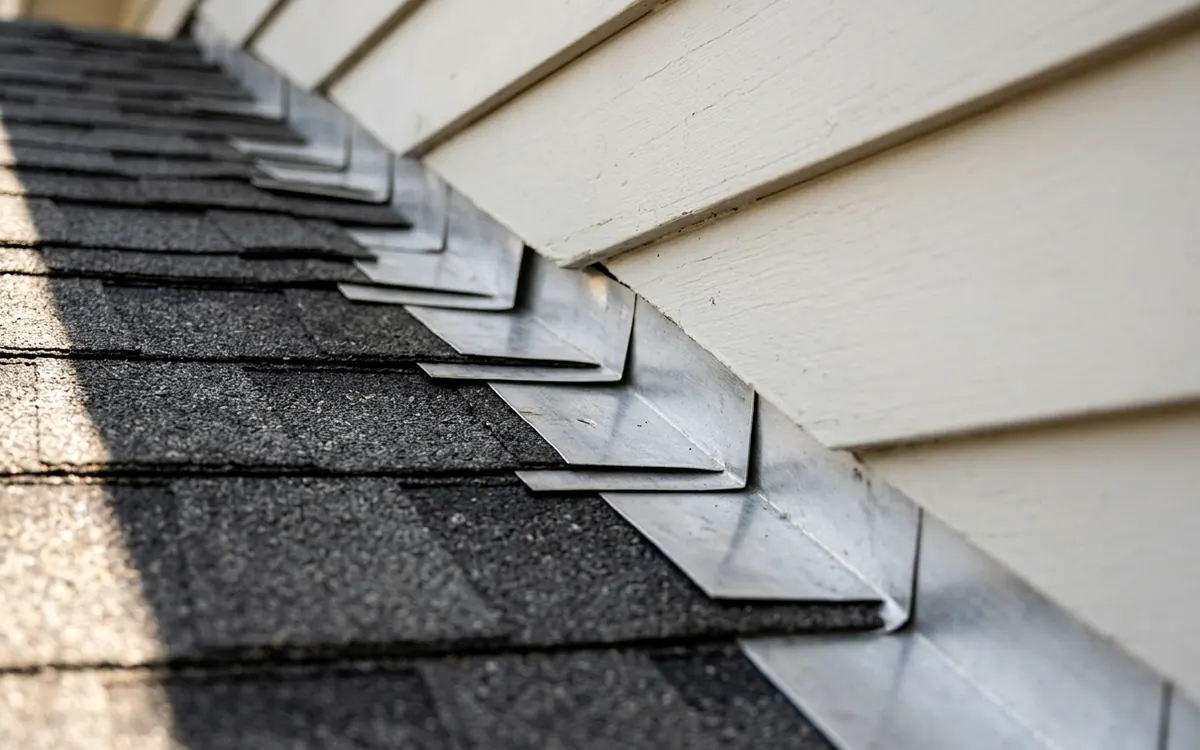
Roof flashing repair replaces or rebuilds the metal and rubber pieces that seal roof joints, including sidewall step flashing, valley metal, pipe boots, and kick-out flashing. You need it when leaks appear near walls, dormers, or vents. We lift the surrounding shingles, install new flashing in proper layers, and weave the shingles back in.
How we handle roof flashing repair on St. Louis homes
Most leaks do not start in the middle of a shingle field. They start where the roof meets something: a wall, a valley, a plumbing vent. Those are the joints where the roof changes direction or runs into something taller, and flashing is the only barrier there. When sealant or metal fails at those spots, water goes straight to the decking.
Good flashing works through layering, not sealant. Step flashing is bent metal installed one piece at a time, each overlapping the next and tucked beneath the siding above, so water runs down and out over each shingle course. Valley metal, vent boots, and kick-out diverters rely on the same principle: upper pieces always lap over lower ones. A bead of caulk is a patch, not a flashing.
Repair means opening the joint. We pull the shingles back along the failed area, replace corroded or missing flashing, and re-lay the shingles over it so they shed water. We also check how the siding or wall cladding above meets the metal, since a gap there can let water run behind the flashing and defeat it entirely.
Flashing materials and methods we use
Aluminum or steel step flashing
Pre-bent pieces installed one per shingle course along a sidewall. Aluminum resists rust, and galvanized steel is stronger. We choose based on the wall and local conditions.
Open and closed valleys
An open valley uses exposed metal that sheds water fast, and a closed valley is covered with woven shingles. We choose the method that suits your roof pitch and shingle type.
Pipe boot upgrades
Plain rubber boots crack early. We replace them with boots that have metal collars or with lead flashing, which can last far longer than the rubber alone.
Kick-out diverters
A small bent-metal piece at the end of a sidewall flashing sends water into the gutter instead of behind the siding. It is cheap protection that many roofs lack.
What does roof flashing repair cost in St. Louis?
Flashing prices depend on the joint. Replacing a single pipe boot is quick and inexpensive. Rebuilding a long sidewall or a cut-up valley takes real time, because shingles must be lifted and relaid around the new metal. Height, pitch, and siding that must be loosened add labor. Old caulk and tar also take time to remove before the new flashing goes in.
Compare every roofing and siding price range or plan the order of your exterior work.
| Work | Typical range |
|---|---|
| Pipe boot replacement, each | $215 to $485 |
| Kick-out flashing installation | $235 to $565 |
| Sidewall step flashing rebuild | $640 to $1,570 |
| Valley rebuild with new metal | $880 to $2,240 |
These ranges are typical for flashing work in the St. Louis area, not a quote, and damaged decking beneath the joint adds to them.
How we rebuild failed roof flashing
- 1
Trace water to the joint
We follow stains and attic moisture to the joint above them, then look at the roof feature itself to confirm the flashing is the culprit and not a nearby shingle.
- 2
Strip shingles back
Shingles along the joint are carefully lifted and set aside. We remove old sealant, corroded metal, and failed boots, down to clean decking and sound underlayment.
- 3
Replace the flashing in layers
New metal goes in one piece at a time, each lapping over the one below, with the top edge tucked behind siding or wall cladding so water cannot run behind.
- 4
Weave shingles back in
Shingles are laid back over the metal, nailed outside the water path, and sealed. The goal is a joint where water runs over every layer, not through it.
- 5
Test and seal exposed edges
We check every lap and fastener, seal exposed edges where code and design call for it, and run water over the joint when the original leak was hard to trace.
Which roof joints give away failing flashing?
Stains beside walls or dormers
A ceiling or wall stain close to where the roof meets a wall or dormer often traces to the step flashing along that joint. Water enters behind the siding and runs down.
Rusted or lifted valley metal
Valleys carry the most water on a roof. Rust, pinholes, or edges that curl up out of the shingles mean the metal is failing and water can slip underneath.
Cracked rubber pipe boots
The rubber collar around a plumbing vent splits in sun long before the shingles wear out. Look for hairline cracks or a collar that has pulled away from the pipe.
Caulk bubbling at wall joints
Thick caulk or tar smeared along a wall joint is a past patch. When it cracks or peels, it shows the underlying flashing was never rebuilt, and water has a path.
Missing kick-out flashing
Where a roof edge ends against a sidewall, a small diverter should send water into the gutter. Without it, you see stained siding or rot just below that corner.
Exposed nail heads on metal
Nails driven through the face of flashing, instead of covered, work loose with temperature changes. Rust trails below them show where water is seeping in.
Where flashing fails on St. Louis houses
Additions are a common weak spot. Many 1950s to 1970s ranches in the county have a later room or garage tied into the main roof, creating a long sidewall joint that was often flashed with caulk. Newer St. Charles County subdivisions have cut-up rooflines with many valleys and dormers, and each valley is a place where thin builder-grade metal can fail early, often well before the shingles around it show any wear at all.
Climate does its part. Freeze-thaw cycles expand and contract metal and sealant through the winter, and humid summer heat bakes rubber boots until they split. On older brick homes, flashing where the roof meets a parapet or party wall takes the same wear. Walls, valleys, and vents fail on different schedules, so we check each joint on its own and replace only the pieces that have actually worn out or pulled loose.

Where we handle roof flashing repair
The city, the counties and the towns below cover most of the homes we work on. If yours is not listed, call and ask.
- City of St. Louis 63102
- St. Louis County, MO 63105
- St. Charles County, MO 63301
- Florissant, MO 63031
- Chesterfield, MO 63017
- Oakville, MO 63129
- St. Charles, MO 63301
- O'Fallon, MO 63366
- St. Peters, MO 63376
- Kirkwood, MO 63122
- Mehlville, MO 63125
- Belleville, IL 62220
- University City, MO 63130
- Ballwin, MO 63011
- Wentzville, MO 63385
- Hazelwood, MO 63042
- Webster Groves, MO 63119
- Edwardsville, IL 62025
- Collinsville, IL 62234
- Alton, IL 62002
- O'Fallon, IL 62269
- Arnold, MO 63010
- Affton, MO 63123
- Jefferson County, MO 63050
Shingle, siding and window lines we install and repair around St. Louis include GAF, Owens Corning, CertainTeed and James Hardie, plus the other brands below.
- GAF
- Owens Corning
- CertainTeed
- IKO
- Atlas
- Malarkey
- James Hardie
- LP SmartSide
- Alside
- Mastic
- DaVinci
- Velux
- Carlisle
- Firestone
Roof Flashing Repair questions
Can roof flashing be fixed with caulk or does it need replacing?
Caulk is a short-term patch at best. Flashing works by overlapping metal that sheds water, and sealant dries, shrinks, and cracks within a few seasons. When the metal is corroded, missing, or installed wrongly, replacing it in layers is the repair that lasts.
What is a kick-out flashing and does my house need one?
It is a small angled piece at the bottom of a sidewall flashing, where a roof edge meets a wall. It sends water into the gutter. If your roof ends against a wall and has no kick-out, water likely runs behind the siding.
How long do rubber pipe boots usually last compared to the shingles?
Rubber boots often split in sun well before the shingles around them wear out, sometimes in under a decade. That is why they are a frequent leak source. Replacing one is a small job that prevents a lot of ceiling damage.
Why does my roof leak at the valley when the shingles look fine?
Valleys carry the water of two slopes, so even a pinhole in the metal or a lifted shingle edge admits a lot. The shingles can look perfect while rust or a gap underneath lets water reach the decking. We look at the metal itself.
Do you replace step flashing without removing my siding?
Usually we loosen the siding above the flashing, instead of removing it, so the new metal can tuck behind it. With some wall types we carefully lift a few courses. Either way, we reseat the siding and check that nothing is damaged.
Related work we often pair with roof flashing repair
Roof Leak Repair
Find the real leak source. The stain on your ceiling is rarely under the hole in your roof.
Chimney Flashing Repair
Brick chimney flashing. Where a brick chimney meets the roof, water has four sides to get in from.
Skylight Repair & Installation
Skylights that stay dry. Most skylight leaks come from the flashing around the unit, not the glass.
Roof Repair
Everyday roof repair. Most roof problems start small: a few lifted shingles, a cracked boot, a nail that backed out.
Need roof flashing repair in St. Louis?
Call any hour. A roofer answers, asks a few questions and sets up a visit.