Standing seam metal roofs in St. Louis with concealed clips
Standing seam panels run unbroken from eave to ridge, held by hidden clips beneath the raised seams. No screws puncture the face, which is why the system suits St. Louis storms and long-term ownership.
- Answered 24/7
- Roof Replacement
- City, county and Metro East
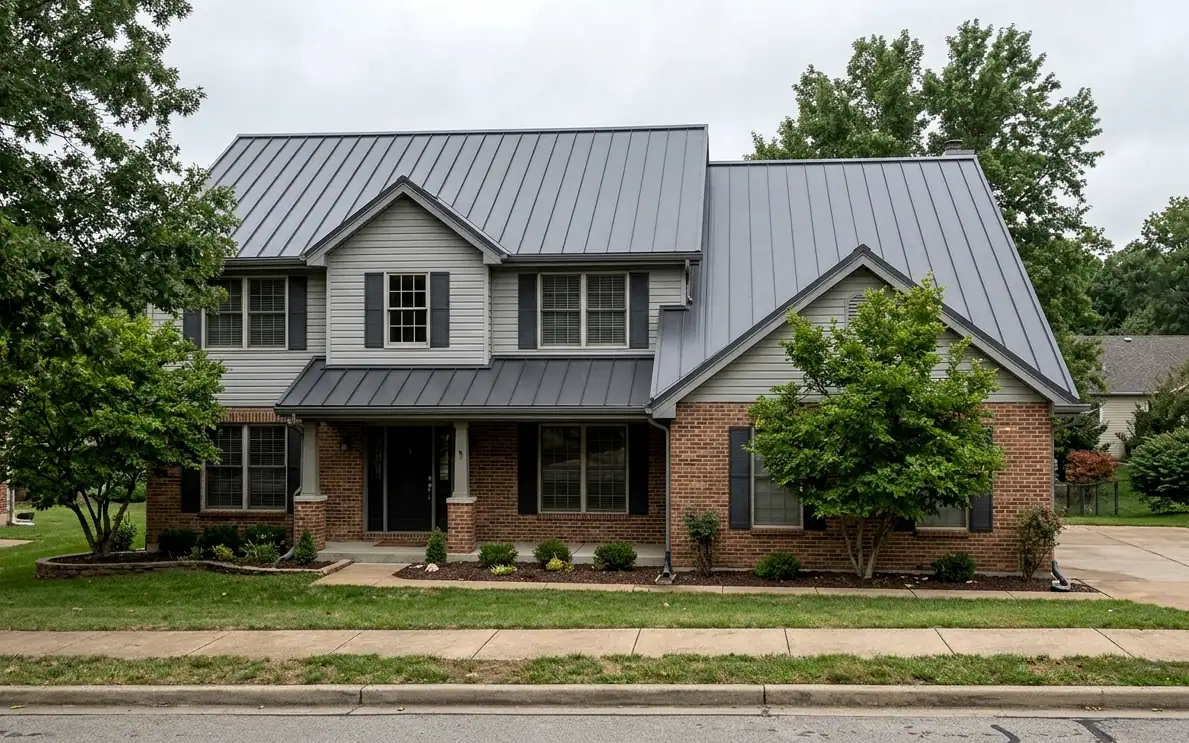
A standing seam metal roof uses long steel or aluminum panels with raised seams that lock together over concealed clips. Nothing is screwed through the face of the panel. You consider it for a long-term roof on a home with clean lines, a low slope, or hail exposure. A visit covers panel gauge, finish, seam type, and flashing details.
How we handle standing seam metal roofs on St. Louis homes
The defining feature of standing seam is what you cannot see. Each panel is fastened with small clips hidden under the seam, and the next panel snaps or folds over the clip. The clips let the panel slide as steel heats and cools through the year, so nothing works loose at a screw hole. That movement is the reason this system outlasts ribbed panels in climates with big seasonal swings.
Panels are often roll-formed on site from a coil, cut to the exact length of each slope. That means no end laps on most roofs, so the only joints are the seams and the flashing at walls, hips, and penetrations. The details at those points, from valley pans to chimney crickets to ridge closures, are where the craft shows. A rushed install fails there long before the panel does.
Standing seam also changes how a house looks. The vertical lines give a crisp, modern appearance on ranches and additions, and they sit well on brick Colonials and farmhouse styles with darker finishes. We help you pick a seam height, a color that works with your masonry, and trim that matches the gutters, since the details are all visible from the street.
What choices go into a standing seam system?
Snap-lock seams
Panels snap together without a seaming tool. Faster to install and well suited to steeper roofs, though they are less weather-tight on very low slopes than a mechanically folded seam.
Mechanically seamed panels
Seams are folded by a roller tool after the panels are set, forming a tighter lock. This is the pick for low-slope roofs and wind-prone sites where extra weather resistance matters.
Steel or aluminum
Painted steel is the common choice and handles hail impacts well. Aluminum resists rust in damp, riverside conditions and is lighter, though it dents more easily, so gauge matters.
Seam height and panel width
Taller seams and narrower panels give a stronger visual line and more rigidity. Wider panels with shallow seams look flatter and cost a little less. We show samples against your siding.
What does a standing seam roof cost in St. Louis?
Standing seam is among the higher-cost roof types. Metal and coil prices, panel gauge, the finish, and the complexity of the roof all move the number, and every hip, valley, or chimney adds custom flashing time. Skilled labor makes up a large part of the price, because poor seaming is hard to fix later. A simple gable roof costs far less per square than a cut-up roof with many dormers.
Compare every roofing and siding price range or plan the order of your exterior work.
| Work | Typical range |
|---|---|
| Standing seam panels, per square installed | $912 to $1,486 |
| Custom valley and wall flashing, per linear foot | $27 to $58 |
| Snow guard system, small to mid-size roof | $486 to $1,280 |
| Standing seam roof, mid-size ranch | $22,380 to $41,760 |
Ranges here are typical for 2026 in St. Louis, not quotes, and the final price depends on gauge, finish, roof shape, and detail work.
How a standing seam roof goes on
- 1
Survey slopes and set layout
We measure each plane, mark the panel layout so seams run straight and square, and note where valleys, hips, and wall tie-ins need custom flashing before coil is ordered.
- 2
Prepare a flat solid deck
Standing seam shows every imperfection below it, so we replace rotted boards, flatten raised nails, and lay a smooth, high-temperature underlayment rated for contact with hot metal.
- 3
Install trim and clips
Drip edge, eave closures, and rake trim go on first. Then the clips are screwed to the deck on layout lines, spaced to the panel manufacturer's requirements.
- 4
Form, set, and seam panels
Panels are formed to length, set onto the clips, and locked by snapping the seam or running a seaming tool along it. Each panel is checked for straightness before the next goes on.
- 5
Flash penetrations and finish the ridge
Chimneys, vents, and walls get custom-formed metal flashing. The ridge cap and closures finish the roof, and we walk you through close-up photos of seams and details.
Is a concealed-clip metal roof worth it for your house?
You want no exposed fasteners
Screw heads and washers are the first things to fail on a ribbed roof. Standing seam moves every fastener under the panel, so there is nothing on the surface to loosen or leak.
Your roof has a shallow pitch
Standing seam handles lower slopes well because water runs along the seams rather than across lap joints. Many manufacturers allow pitches that no shingle product accepts.
Long runs from eave to ridge
Simple roof planes with few penetrations show standing seam at its best. Fewer cuts and valleys mean cleaner lines and fewer flashing points to maintain.
You have had hail trouble
A heavier-gauge standing seam panel stands up better to hail than thin ribbed sheets. Small dents can still show on flat panels, so a striated or textured panel hides them.
Snow slides cause problems
Smooth panels shed snow quickly. Snow guards clamped to the seams control the slide, with no holes drilled through the panel face to hold them.
Your next roof should be the last
If you plan to stay in the house for decades, a metal system with concealed clips costs more now but avoids one or two full shingle replacements down the road.
Standing seam on St. Louis brick homes, ranches, and new builds
Standing seam is most common on newer builds in St. Charles County and on St. Louis County remodels, where homeowners are redoing a ranch or two-story and want a clean, modern roof line. In the city, it works on additions, garage conversions, and low-slope sections behind a historic front. We keep panel color away from glare, since a bright reflective finish next to a brick facade can look harsh in afternoon sun.
Weather drives the details. Spring hail calls for a heavier gauge, summer humidity means condensation control under the panels, and freeze-thaw cycles put stress on flashings at walls and chimneys. Ice and water membrane under the metal at eaves and valleys catches any melt that backs up. Because panels run long, we plan the work around wind, which can make big sheets difficult to handle.
Where we handle standing seam metal roofs
The city, the counties and the towns below cover most of the homes we work on. If yours is not listed, call and ask.
- City of St. Louis 63102
- St. Louis County, MO 63105
- St. Charles County, MO 63301
- Florissant, MO 63031
- Chesterfield, MO 63017
- Oakville, MO 63129
- St. Charles, MO 63301
- O'Fallon, MO 63366
- St. Peters, MO 63376
- Kirkwood, MO 63122
- Mehlville, MO 63125
- Belleville, IL 62220
- University City, MO 63130
- Ballwin, MO 63011
- Wentzville, MO 63385
- Hazelwood, MO 63042
- Webster Groves, MO 63119
- Edwardsville, IL 62025
- Collinsville, IL 62234
- Alton, IL 62002
- O'Fallon, IL 62269
- Arnold, MO 63010
- Affton, MO 63123
- Jefferson County, MO 63050
Shingle, siding and window lines we install and repair around St. Louis include GAF, Owens Corning, CertainTeed and James Hardie, plus the other brands below.
- GAF
- Owens Corning
- CertainTeed
- IKO
- Atlas
- Malarkey
- James Hardie
- LP SmartSide
- Alside
- Mastic
- DaVinci
- Velux
- Carlisle
- Firestone
Standing Seam Metal Roofs questions
Do concealed clips let standing seam panels move with summer heat?
Yes, that is their job. Steel expands in July sun and contracts in January cold, and the clips hold the panel in place while allowing it to slide slightly. Because no screw goes through the face of the panel, there is no hole to stretch or leak. Fixed fasteners would work loose over time.
What gauge steel is best for standing seam roofing in St. Louis County?
Many residential jobs use 24 gauge steel, which is thicker and stiffer than 26 gauge and resists oil canning and hail dents better. Thinner gauge can save money on a simple roof, but heavier steel is a sound choice where hail is a regular risk. We show samples and discuss the tradeoff before you choose.
Can standing seam be installed on a low-slope porch or addition roof?
Yes, a mechanically seamed standing seam panel works on very low pitches, often as low as one-half to one inch of rise per foot depending on the product. That makes it useful for porch roofs, additions, and rear sections where shingles are not allowed. The underlayment and seam type must match the slope.
How are standing seam panels cut to length for long roof runs?
Panels are commonly roll-formed on site from a steel coil, so each one is cut to match its slope from eave to ridge. That avoids splices and end laps on most roofs. It also means we need driveway or yard space for the roll-forming equipment on the day of install.
Why do standing seam roofs show a wavy look called oil canning?
Oil canning is a slight visible waviness in flat metal panels, caused by stress in the coil, thin gauge, or an uneven deck. It is cosmetic and does not affect performance. Heavier gauge, striations in the panel, a flat deck, and careful installation reduce it, and a lower-gloss finish hides it.
Related work we often pair with standing seam metal roofs
Metal Roofing
Steel and aluminum roofs. Metal roofing covers more than one product.
Roof Replacement
Full tear-off, start to finish. A roof replacement strips the old covering down to the deck, repairs what is hiding underneath, and builds a new system on top.
Roof Flashing Repair
Flashing joint repair. Flashing is the thin metal and rubber that turns water away at every joint in a roof.
Gutter Guards
Fewer clogs, fewer ladder trips. Gutter guards keep leaves and debris out of the trough so water can flow.
Need standing seam metal roofs in St. Louis?
Call any hour. A roofer answers, asks a few questions and sets up a visit.