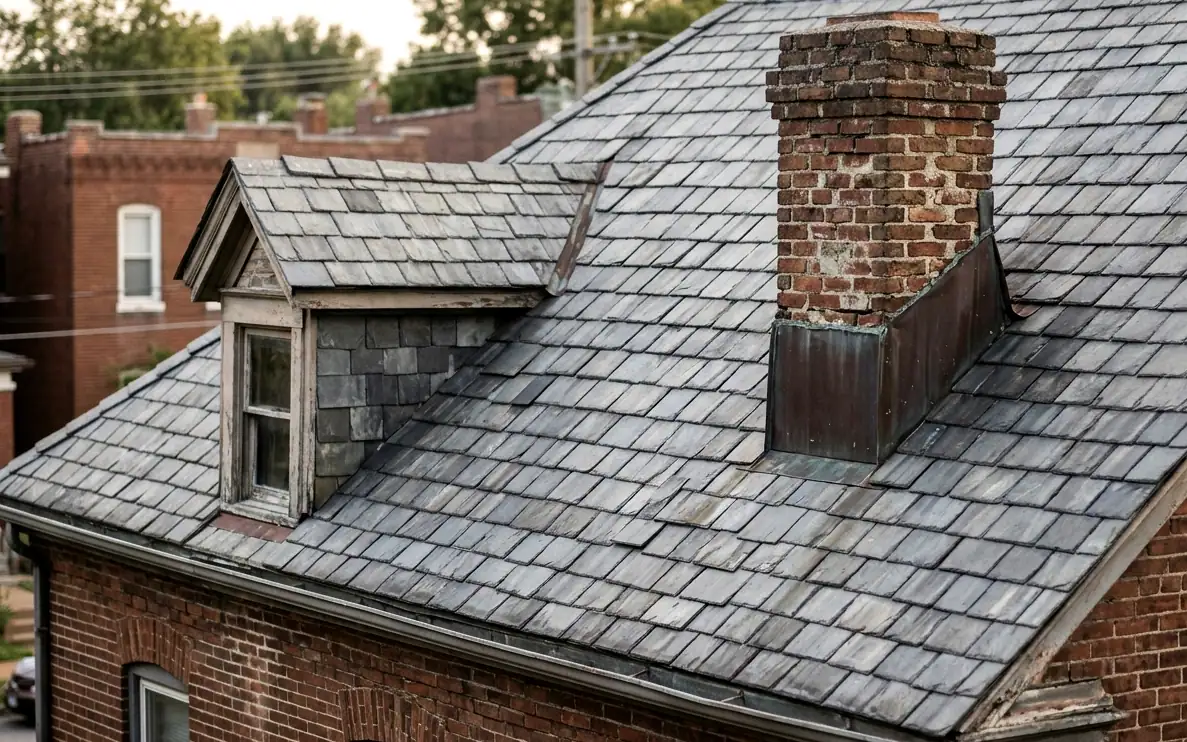
Why the slate outlives the roof built around it
Good hard slate can last well past a century, but the roof system around it does not. Each slate hangs on two nails, and on roofs from the early 1900s those nails were often plain steel. Steel rusts through in forty to sixty years. When the nails go, the slates slide down a few inches at a time, even though the stone itself is perfectly sound.
The other weak points are the metal and the felt. Valleys, flashing around chimneys, and the gutters on older brick homes were made of materials that give out long before the slate does. Many slate roofs that leak have nothing wrong with the slate at all. The failure is a few inches of corroded flashing that was patched with tar.
Slipped, cracked, and flaking slates tell different stories
Look at the pattern, not just the count. Isolated broken slates near a satellite dish, a chimney, or a spot where someone walked the roof point to a local problem. Slates that have slipped in rows across a whole slope point to failed nails, which is a systemic problem that will keep producing repairs. Slates that flake in layers or turn soft and chalky have reached the end of their stone.
Standing in the yard with binoculars you can usually see the difference. Sliding slates leave visible gaps and staggered lines. Broken slates leave notched edges and bright new surfaces where pieces fell away. In the attic, scattered daylight and a floor of slate chips under one slope tell the story faster than a ladder inspection.
- Most slate roofs fail at the nails, flashing, or felt long before the stone itself wears out.
- Slipped slates across a whole slope point to failed fasteners and a repair pattern that keeps repeating.
- Spot repairs make sense below roughly fifteen to twenty-five percent damage per slope, and relaying makes sense above it.
- Replacement can reuse sound slate, or switch to synthetic slate, so weigh the structure and the budget together.
A practical line between repair and replacement
There is no exact formula, but a common rule of thumb is this. When fifteen to twenty-five percent of the slates on a slope have slipped, cracked, or flaked, spot repairs stop paying for themselves. You will keep paying a repair visit every few months, and each patch disturbs the slates around it. At that point relaying the slope or replacing it is the better use of money.
Below that threshold, repair is usually right. A cluster of broken slates, a failed valley, or a chimney flashing leak can be fixed on a roof that is otherwise healthy. We tell you which situation you have and show you the attic and roof photos that back it up, including cases where the honest answer is to leave the roof alone.
What a proper slate repair involves
Done right, a repair does not use nails or tar. The crew lifts the slates above the break with a slate ripper, cuts out the damaged slate, and slides in a matching one held by a copper or stainless hook. We match thickness and color, often salvaging slates from a back slope or a chimney side that is less visible. Caulk and roofing cement are not repairs.
Flashing should be copper or another long-lived metal, formed to fit and woven into the courses. Small repair visits on an accessible roof typically run $487 to $1,260 depending on the number of slates and how hard the roof is to reach. A single replaced slate is usually priced at $38 to $96 each on top of the access cost.
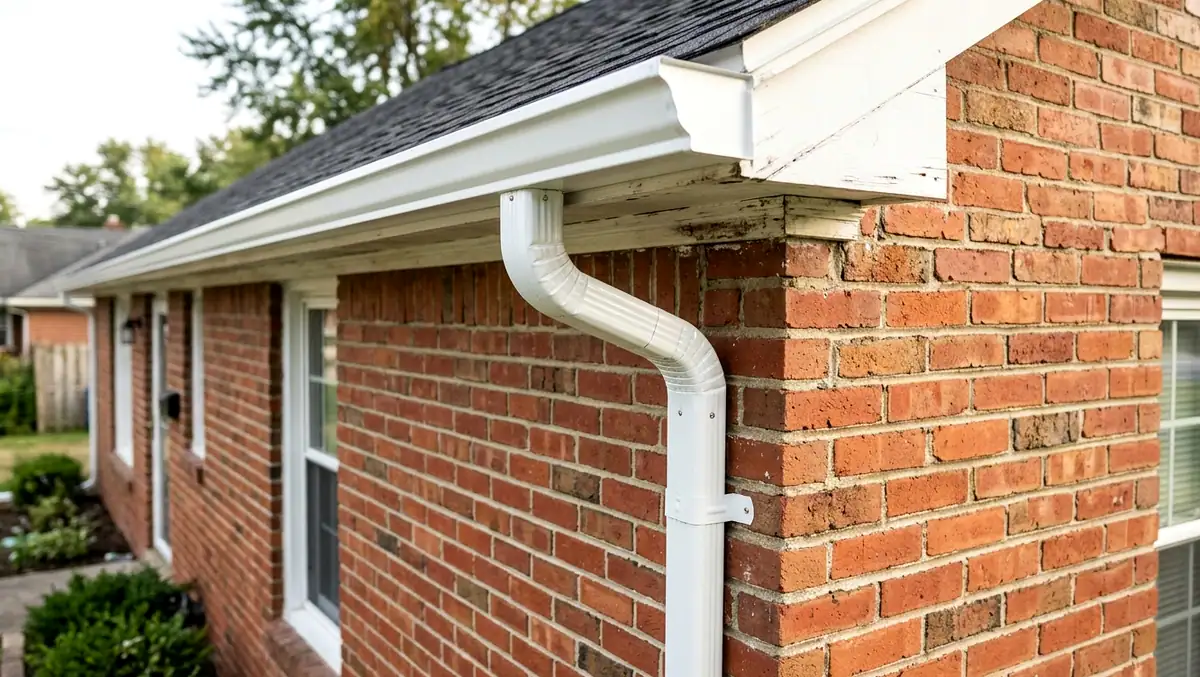
What replacement actually means for a slate roof
Replacement does not always mean throwing the slate away. On a sound roof with failed fasteners, the better option is often to strip the slope, save the good slates, replace the underlayment and flashing, and reinstall them with new hooks or nails. Reclaimed slate costs more in labor but keeps the original look, which matters on a historic brick home.
If the slates are tired or the budget is tight, synthetic slate and designer shingles reproduce the look at a lower price. Before choosing, check the structure. Real slate is heavy, and a roof framed for it may not carry other materials well, or may be overbuilt for something lighter. Either way the deck gets checked.
Questions to ask before you hire anyone
Ask who will actually walk the roof and how. Slate cracks under bad footing, so crews should use roof ladders or hooks and never step on unsupported slates. Ask where replacement slates come from, what the flashing metal will be, and how the fasteners are chosen. A vague answer on any of those means you may be paying for a patch that will fail.
Ask also for the attic photos and the roof photos together. We walk you through what the shingle and slate look like up close, point out the failed nails or flashing, and then tell you what we would do if the roof were on our house. Call (314) 461-6440 and we will schedule a visit to look.
Elmer writes and updates the Exterior Guides for Stars and Stripes Roofing and Exteriors, drawing on the roofs, siding and gutters our crews work on across St. Louis, St. Louis County, St. Charles County and the Metro East.