Size in squares sets the starting number
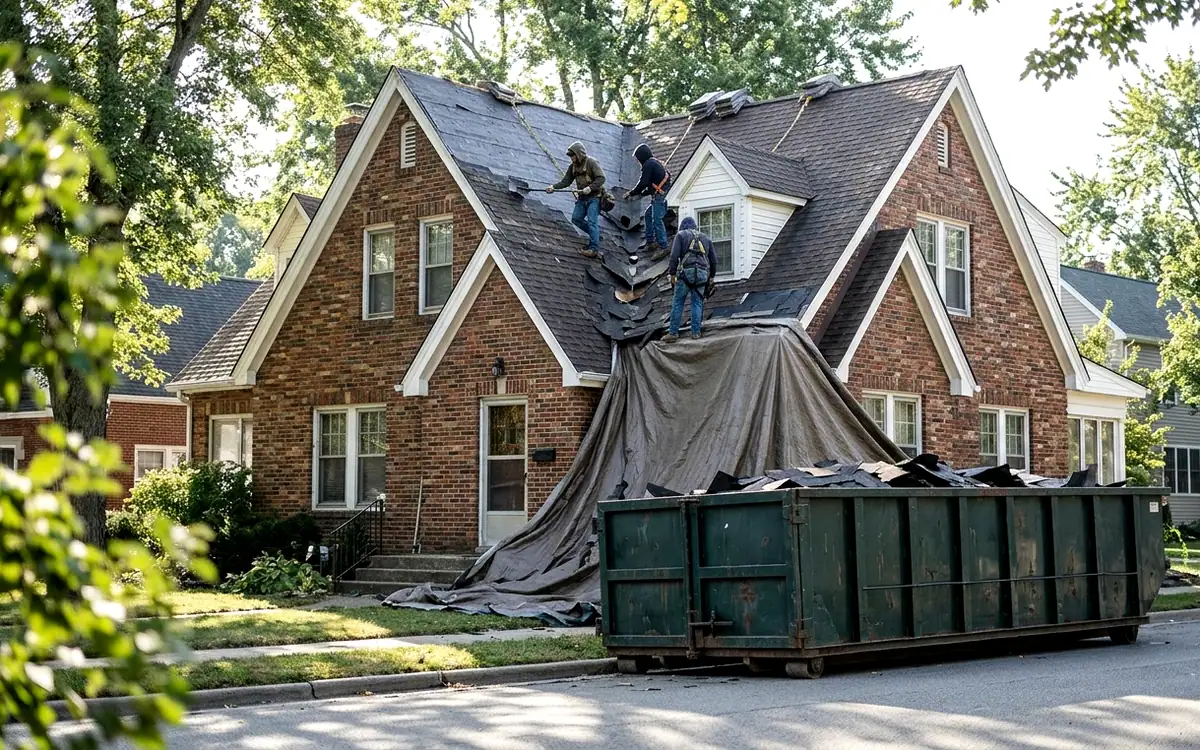
Roofers price by the square, which is 100 square feet of roof surface. A small bungalow might run 14 to 20 squares, a 1960s ranch in the county 24 to 36, and a two-story brick home in the city with hips and dormers 26 to 40. Crews add ten to fifteen percent for waste on cut-up roofs, so the order is always larger than the footprint suggests.
For architectural asphalt shingles, a typical installed range in this market is $465 to $712 per square. On a 28 square roof that works out to roughly $13,020 to $19,936. Use those numbers to sanity check an estimate, not to predict yours, because every line below can push the total up or down.
Pitch and roof shape change the labor
A low slope walks easily and a steep one does not. Past about 8 in 12, crews need roof jacks, toe boards, and harnesses on every pitch, and production drops sharply. Steep gables on older city homes can add a fifth or more to the labor line, and the price goes up again for slopes over a second story where material has to be carried by hand.
Shape matters as much as steepness. Every hip, valley, dormer, and chimney is a place where shingles are cut, flashing is formed, and leaks like to start. A plain gable roof of 30 squares can cost less than a 24 square roof broken into six planes, because the cutting and flashing take far longer than the field shingles.
- Price is driven by squares, pitch, cut-up roof shape, layers, decking condition, material, and access to the house.
- Typical architectural shingle replacement runs about $465 to $712 per square installed in the St. Louis market.
- Ask for decking to be priced per sheet so a soft spot never turns into a surprise charge.
- Compare materials on the same house with the same underlayment and flashing details, not by headline price.
Layers and tear-off are the hidden labor
Most crews strip the roof to the deck so they can see what is underneath. Older St. Louis homes often have two or even three layers of shingles from past re-roofs, and every extra layer adds weight to haul, more dump fees, and slower work. Expect an added $38 to $74 per square for a second layer, and more where the old roofing is slate or tile.
Access affects tear-off too. A rowhouse with no driveway may need a dumpster on the street, a permit for it, and debris carried down by chute. A suburban lot lets a truck park near the eave. Tell us about the lot and the street when you call, because it changes how the day runs and what it costs.
Decking is the line that surprises people
Once the old roofing is off, the deck either holds up or it does not. Rot hides near chimneys, valleys, and the spots that leaked for years. Newer homes have plywood or OSB, and replacing a bad sheet typically runs $74 to $118. Many pre-1950 homes have plank decking with gaps between boards, and most shingle makers want a solid surface, so those roofs usually get covered with new sheathing.
That is why a good estimate names a price per sheet instead of a vague allowance. You want to know the number before the crew finds the soft spot, not after. We photograph every bad section during tear-off and walk you through the pictures so the final bill matches what was actually replaced. That keeps the final invoice honest and the surprise factor low.
Material sets the price floor and ceiling
Asphalt shingles are the baseline. Standing seam metal commonly lands between $1,138 and $1,642 per square installed, synthetic slate between $812 and $1,186, and real slate between $1,684 and $3,140. Clay tile sits near slate. Those gaps come from material cost, but also from how long each takes to install and how many crew members it needs.
The cheapest material is not always the cheapest roof. A metal roof can outlast two asphalt roofs, and a flat roof membrane priced per square foot reads very differently from shingles priced per square. Ask for each option on the same house, with the same underlayment and flashing details, so the comparison is fair. The honest answer to which material costs least is the one that fits the house and the next twenty years.
How to read an estimate before you say yes
A usable estimate lists the squares, the layers being removed, the underlayment, ice barrier at eaves and valleys, drip edge, flashing, vents, and the decking price per sheet. It names the shingle line by manufacturer and product name. It says who handles the permit, which is generally required for a full replacement in the city and many county municipalities, and who cleans up the nails.
Be careful with an estimate that is a single lump sum on a half page. Lump sums hide the decisions that decide how long the roof lasts. Call us at (314) 461-6440 and we will go through your house line by line, explain what each line does, and tell you which ones can flex and which cannot.
Elmer writes and updates the Exterior Guides for Stars and Stripes Roofing and Exteriors, drawing on the roofs, siding and gutters our crews work on across St. Louis, St. Louis County, St. Charles County and the Metro East.