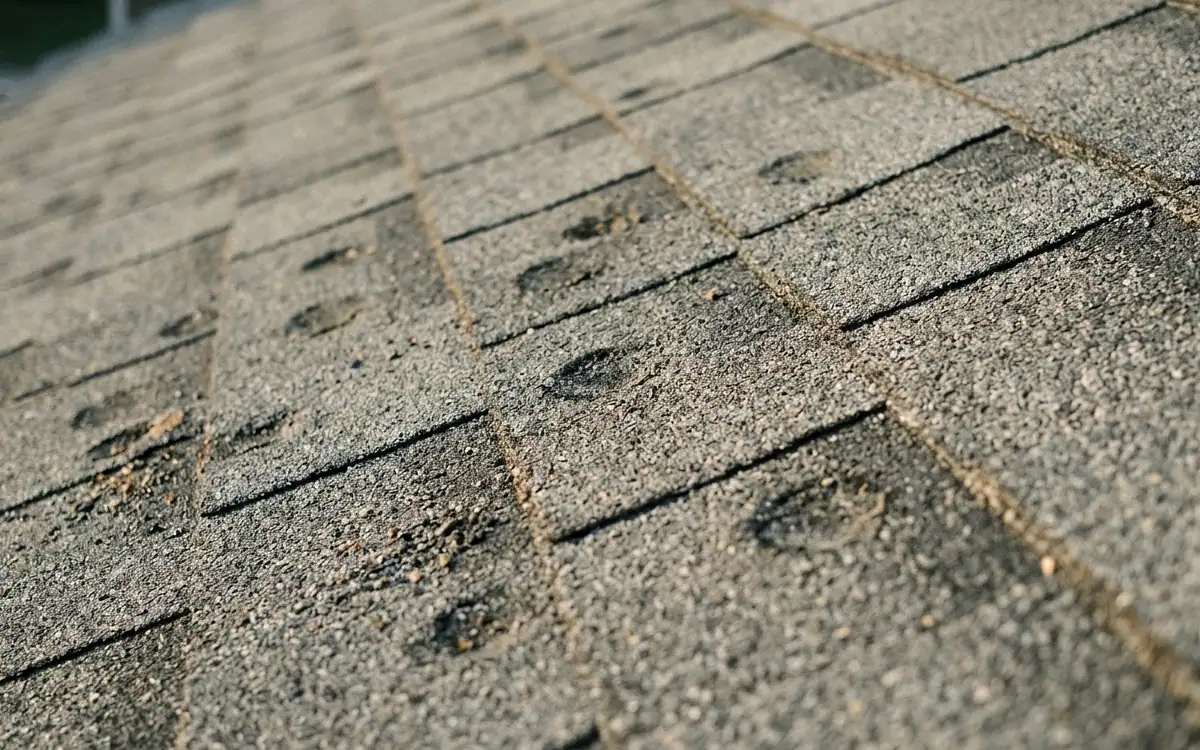
What hail actually does to shingles and metal
Hail does not need to punch a hole to shorten a roof's life. On asphalt shingles, a strike knocks granules loose and leaves a bruise, a soft spot where the fiberglass mat underneath has cracked. The mat holds the shingle together, so a bruised shingle sheds water for a while and then starts to leak or curl years early. Stones around an inch across are usually enough, and brittle older shingles can bruise from smaller ones.
Metal and soft components tell a different story. Standing seam and ribbed panels dent, and most of the time the dents are cosmetic, though thin panels can open at a seam or a fastener. Vent caps, flashing, and ridge caps are softer than the roof field, so they show the size and direction of the hail more clearly than the shingles do.
Why St. Louis roofs take so many hits
Our spring storm season brings cells that drop hail in narrow swaths, so one block can get an inch of ice while the next street only gets rain. That is why neighbors disagree about whether a storm did anything. Damage follows the storm track, and the slopes facing into the wind take the worst of it, which is often the west and south sides. Tell us which way the storm came from and we know which slopes to read first.
Roof age matters as much as stone size. A shingle roof that has baked through twelve or fifteen Missouri summers has lost some flexibility and a lot of its granule cushion. The same hailstone that bounces off a new roof can crack an old one, so age and storm history together decide how a roof reads after the weather passes.
- Hail can crack the shingle mat and cut a roof's life short without causing a single leak right away.
- Dents in downspouts, screens, and vent caps are the fastest ground-level proof that hail fell hard.
- Check from the driveway with binoculars and photograph everything within a day, but stay off a wet roof.
- Get a slope-by-slope inspection with photos before you sign anything, especially after a big spring storm.
What you can check from the ground
Start with the soft metal you can see without a ladder. Look at the downspouts, the gutter faces, window screens, the cap on the air conditioner condenser, and any painted garage door or mailbox. Round dents of similar size and spacing tell you the hail fell hard enough to matter. Check the siding on the windward wall too, since hail leaves chipped paint and small round divots on vinyl and wood.
Next, look at the ground under each downspout. A pile of dark granules in a splash block or at the outlet means the shingles are shedding their surface. Walk the yard for shingle fragments or cracked ridge caps, and use binoculars from the driveway to look for pale spots on the roof. Never climb a wet or hail-slick roof to look for yourself.
Signs that say call us before the next rain
Some signs mean the roof is already open. A fresh stain on a ceiling, daylight in the attic, or damp insulation under one slope all point to a path for water. Even without those, a roof with scattered bruising will take on water in the next hard rain through the cracked mat. A visit within the week is smart, and we answer the phone at any hour if water is already coming in.
If a ceiling is dripping, set a bucket, move furniture, and puncture a sagging ceiling bubble with a screwdriver so the water drains in one place instead of spreading. Then call us. A temporary tarp on the damaged slope buys time while the repair plan gets sorted out, and it keeps a small problem from turning into soaked insulation and ruined drywall.

What a proper hail inspection looks like
A real inspection goes slope by slope. We mark a test square, ten feet by ten feet, on each slope and count the hits inside it, then circle each hit with chalk and photograph it so the damage is visible to anyone reading the report. We also check the soft metals, the flashing, the vents, and the attic underside, where cracked mats and daylight sometimes show up before they do outside.
You get the photos and a plain explanation of what we saw, including slopes that came through fine. Sometimes the roof is fine and we say so. Sometimes the damage is spotty enough to repair, and sometimes a whole slope needs replacing. The count of hits, the age of the roof, and the brittleness of the shingle all go into that call.
What to do in the first week after a storm
Photograph everything the day after the storm while the evidence is fresh: dented metal, granules, debris, and any ceiling stain. Hail marks on painted metal fade after a few weeks of weather. Write down the date and time the storm hit. Those notes help if you open an insurance claim later, and they help us know which storm we are looking at when more than one crossed the area in the same month.
Then call before you hire anyone who knocks on your door. After big storms, crews from other cities show up and are gone by summer. Ask for the photos, ask what the plan is for flashing and vents, and ask who you can reach once the job is done. You can reach us at (314) 461-6440 any time, day or night.
Elmer writes and updates the Exterior Guides for Stars and Stripes Roofing and Exteriors, drawing on the roofs, siding and gutters our crews work on across St. Louis, St. Louis County, St. Charles County and the Metro East.