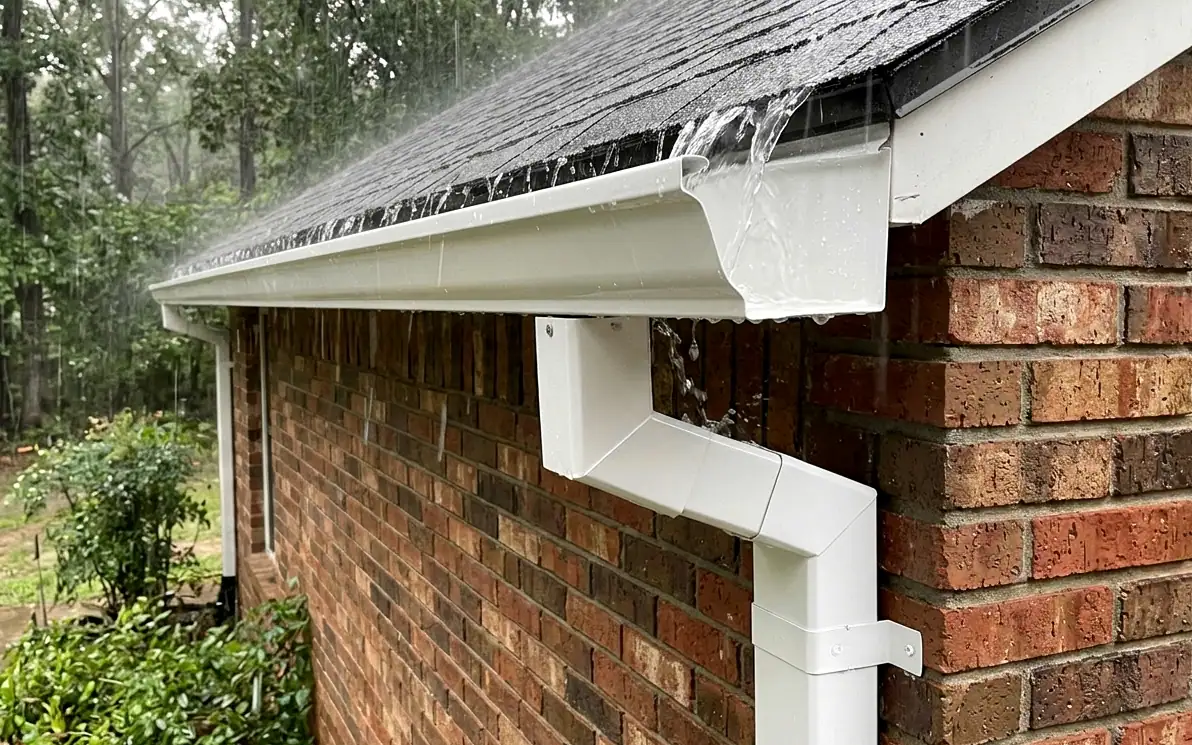
Why St. Louis storms overwhelm undersized gutters
Our summer thunderstorms can drop an inch or more of rain in an hour, and a roof turns every drop into runoff within seconds. A roof with 1,800 square feet of surface sends hundreds of gallons toward the gutter in a single burst. If the trough, the outlet, or the downspout is too small, the water goes over the edge.
Overflow causes real damage. It runs down the siding, stains brick, washes out flower beds, and soaks the ground along the foundation. On older homes it also finds the fascia and soffit, where wood rots quietly. The cure is not a better weather forecast but a system sized for the roof it serves, with enough outlets to keep the water moving instead of waiting in the trough.
Five inch versus six inch gutters
Five inch K-style gutters are the default on most American houses and work fine for small roofs with moderate pitch. A six inch gutter holds and moves roughly half again as much water, and it costs only a few dollars more per linear foot. On a big or steep roof, that extra capacity is the cheapest storm insurance in the whole system.
We recommend six inch for roofs over about 1,500 square feet of surface, steep pitches, long runs, and homes with valleys that deliver a lot of water to one point. Five inch is reasonable for small bungalows and short runs with low pitch. Match the gutter to the roof, not to what the neighbor installed.
- Six inch gutters move about half again as much water as five inch and suit large or steep roofs.
- A 3 by 4 inch downspout drains roughly twice what a 2 by 3 inch downspout does.
- Plan one downspout per 30 to 40 feet of gutter, and add outlets where valleys deliver heavy flow.
- Send discharge at least four to six feet from the foundation and away from walkways and neighbors.
Downspout size and how many you need
The downspout is often the bottleneck. A standard 2 by 3 inch downspout has half the opening of a 3 by 4 inch downspout, so upgrading it can double what gets drained. Oversized gutters with undersized downspouts back up, which is why the two should be chosen together. Bigger troughs only help if the water can leave them quickly, so check the outlet size on any quote.
As a rule of thumb, plan for one downspout for every 30 to 40 feet of gutter, and add one wherever a long run or a large roof section dumps water to a single point. A fifty foot gutter with one downspout at the far end will overflow in a hard rain. Put the outlet where the water naturally collects, and never trust a single downspout to drain a long run that slopes the wrong way for the house.
Where downspouts should go
Placement matters as much as count. Put downspouts at corners and low points, near valleys that concentrate the flow, and away from entries and walkways where winter ice would form. Avoid splitting a short run into awkward spots just to match the house. A well-placed downspout is less visible and works better, and it keeps the discharge on the part of the yard that can handle it.
Where the water lands is half the job. Extend each discharge at least four to six feet from the foundation with a buried line or a splash block, and never aim it at a neighbor's yard, a driveway apron, or a basement window well. Many wet basements in older city homes trace back to downspouts that dump at the wall.

Pitch, hangers, and valleys
A gutter should slope about a quarter inch for every ten feet toward the downspout so water keeps moving. Too flat and it pools, too steep and it overshoots at corners. Hidden hangers spaced every two feet or closer hold the weight of water, leaves, and ice, and fascia screws grip better than nails that back out over time.
Valleys are where the biggest surges happen. Two roof planes funnel their flow into a narrow stripe, and water shoots past the gutter at speed. Valley splash guards or a larger outlet help. Steep roofs can also shoot water over the top, so a taller back edge or a drip edge adjustment is often needed.
Special cases: guards, dormers, and big roofs
Gutter guards help keep leaves out, but in a hard downpour some designs let water skip over the top. If you add guards, size the gutter generously and pick a design tested for heavy flow. A clean gutter without guards often handles a storm better than a clogged one with them, so cleaning schedules and guard choice should be decided together.
Large dormer roofs, tall two-story walls, and additions that drain into a lower roof need special attention, because water from the upper roof lands on the lower one in a stream. We walk the roof and draw the water paths on the property before we recommend anything. Call (314) 461-6440 and we will review your gutters in a rain-day mindset.
Elmer writes and updates the Exterior Guides for Stars and Stripes Roofing and Exteriors, drawing on the roofs, siding and gutters our crews work on across St. Louis, St. Louis County, St. Charles County and the Metro East.