Why parapet flats are harder than they look
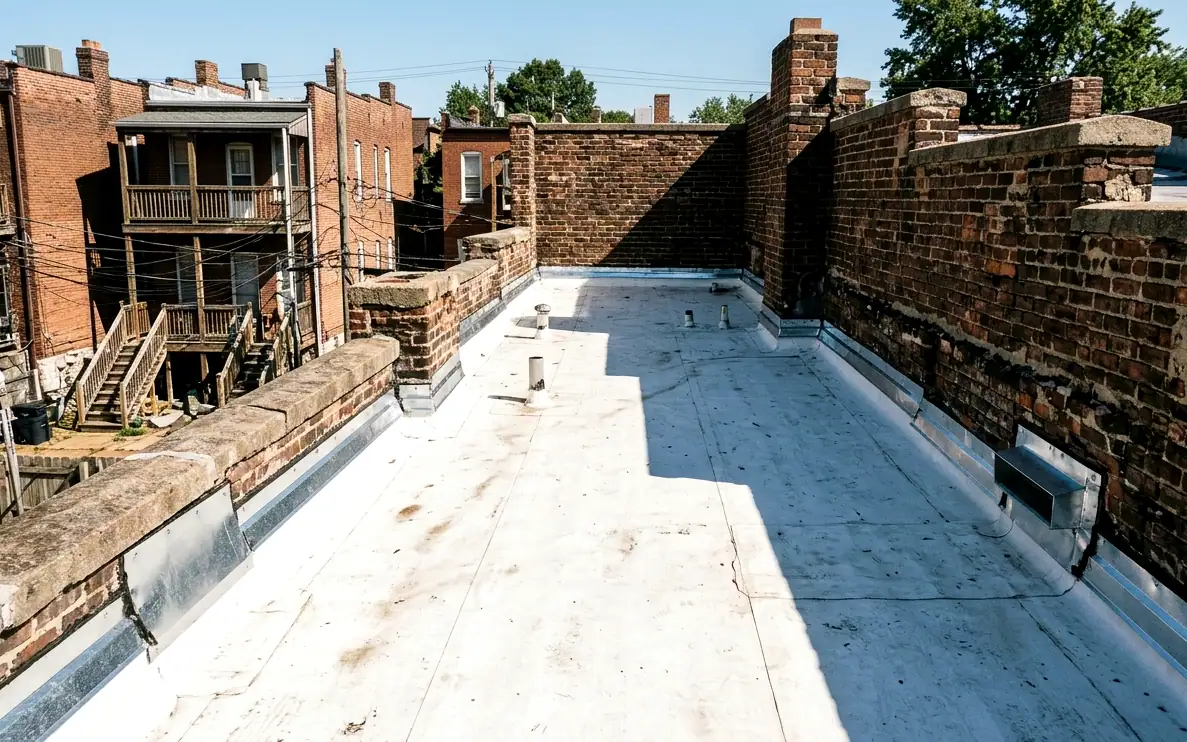
Many two-family and four-family brick flats in the city have a flat or nearly flat roof surrounded by parapet walls on two, three, or four sides. Rain collects against those walls, runs to a scupper or interior drain, and sits there if the roof sags. Every wall edge is a seam where water can enter.
Add the age of the buildings and the roof deck is often old wood that has moved over decades. Sags create ponds, and ponds add weight and speed up the membrane's aging. A good flat roof job starts with reading the slope and drains before any material gets chosen, because the best membrane in the world fails on a roof that holds water.
TPO: white, reflective, heat-welded
TPO is a single-ply white membrane whose seams are welded with hot air, forming a bond as strong as the sheet itself. It reflects sunlight, which helps keep top-floor units cooler in our humid summers. Typical installed prices run $5.20 to $8.90 per square foot, depending on insulation and the amount of detail work.
TPO fits larger, simple roofs well. On a small parapet roof with lots of corners, the seams multiply, and the quality of the welding matters more. Ask whether the membrane is mechanically fastened or fully adhered, how the wall edges are flashed, and what the base flashing is made of before you accept the price.
- On a parapet flat, the wall flashing and drains matter as much as the membrane you choose.
- TPO reflects heat and welds into strong seams, while EPDM stretches well and suits small, cut-up roofs.
- Modified bitumen handles foot traffic, but the installation method near old wood needs careful thought.
- Coatings can extend a dry, sound roof, but they cannot fix ponding or saturated insulation underneath.
EPDM: black rubber with a long track record
EPDM is a synthetic rubber sheet that has covered flat roofs for decades. It stretches with the building, tolerates cold well, and large sheets mean fewer seams on a small flat. It is usually fully adhered to the insulation on a flat with parapets, and its field seams are glued or taped. That tolerance is useful on older buildings where the walls and deck have shifted over the decades.
The black surface absorbs heat, which can raise the temperature of the top floor in summer, though white versions exist. Penetrations and corners are formed with separate flashing pieces, so the skill of the installer shows in those details. It is often one of the most economical choices at about $4.60 to $7.80 per square foot.
Modified bitumen: layers that handle foot traffic
Modified bitumen is an asphalt-based sheet reinforced with polyester or fiberglass, applied in two layers or in a base and cap sheet system. The granulated cap sheet tolerates foot traffic from roof access, satellite installers, and HVAC visits better than a thin single-ply membrane. It is a familiar choice on older brick buildings.
Installation method matters. Open flame near old wood framing and brick cornices is a concern, so many crews use self-adhered or cold-applied sheets in dense neighborhoods. Expect roughly $5.80 to $9.40 per square foot installed. It is heavier than single-ply systems, and seams at wall edges need careful detailing. On a four-unit flat where the roof is the only barrier over several apartments, that extra toughness counts.
Coatings: when a restoration makes sense
A silicone or acrylic coating is a liquid membrane rolled or sprayed over an existing roof. It can extend the life of a sound roof, seal small cracks, and reflect heat. It works best when the existing membrane is dry, well adhered, and not saturated. Coating over wet insulation just traps the problem. Coatings are also an option for a metal roof or a modified bitumen roof that is still tight.
We test for moisture first, repair seams and flashing, and then apply the coating at the right thickness. Coatings cost less than replacement at roughly $2.10 to $4.30 per square foot, but they are not a fix for sagging decks or standing water. On a roof with ponds that stay for days, replacement is the better answer.
The details that decide how long a flat roof lasts
Whatever material you pick, the life of a parapet flat depends on a few details: base flashing carried high up the wall, counterflashing set into the mortar joints or under the coping, a coping cap that sheds water, and scuppers or drains sized and positioned to clear the roof. Tapered insulation can add the slope that the old deck lost.
Ask each bidder to explain these details, not just the membrane. Then ask who will check the roof after the first heavy rain. We climb up after the first storm to see how the water actually moves. Call (314) 461-6440 and we will inspect your flat and talk through the options. That habit has caught more small problems than any spec sheet ever could.
Elmer writes and updates the Exterior Guides for Stars and Stripes Roofing and Exteriors, drawing on the roofs, siding and gutters our crews work on across St. Louis, St. Louis County, St. Charles County and the Metro East.